QR Code Marketing Strategy: 15 Campaign Types That Work in 2026
A practical QR code marketing playbook: 15 campaign types with real examples, a channel-by-channel breakdown, attribution setup, and the mistakes that quietly waste budget. Updated June 2026.

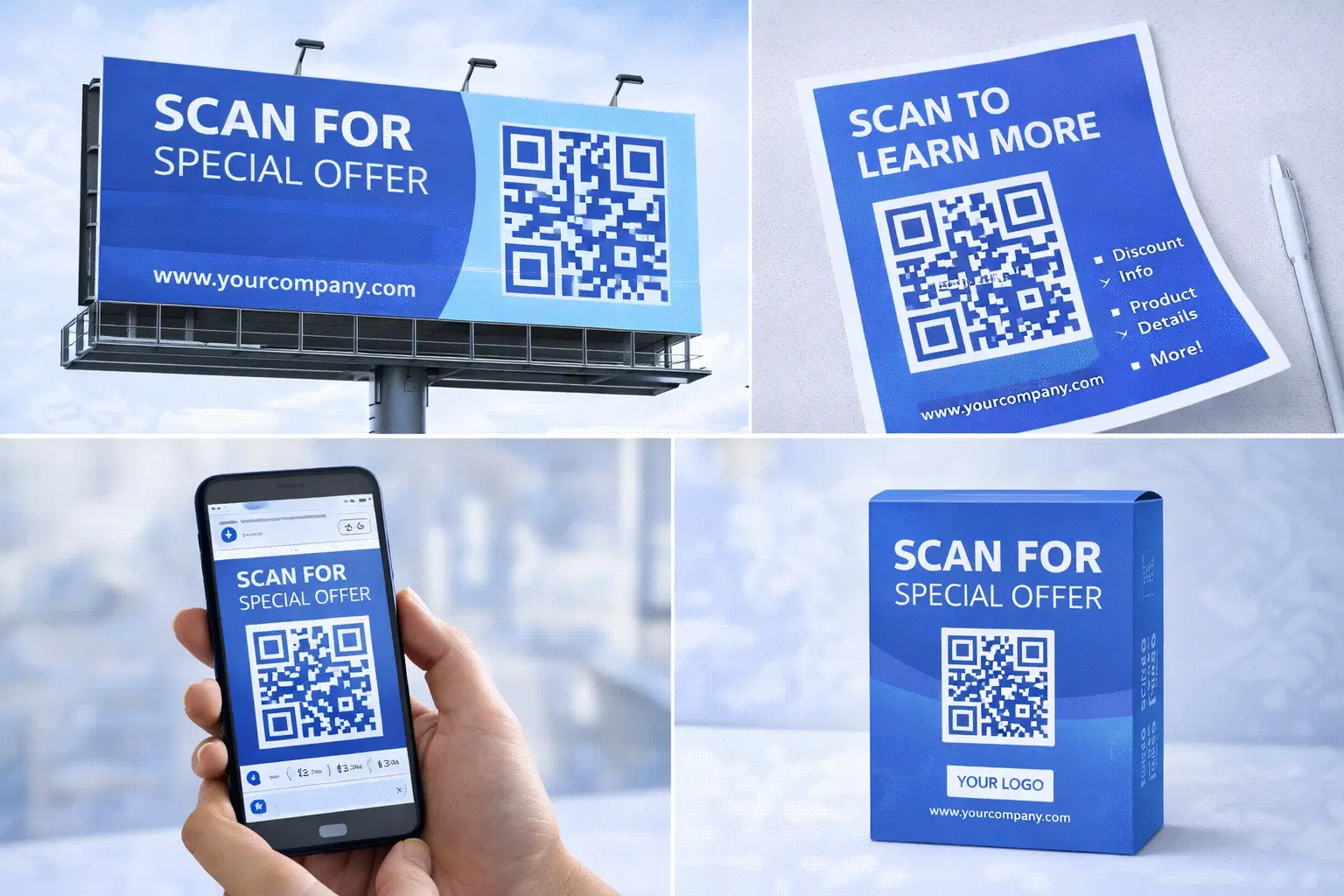
QR codes offer what few marketing tools can: a direct bridge between physical and digital experiences, with full measurement on the digital side. Since smartphone cameras started scanning codes natively (no app required), multiple industry surveys published between 2023 and 2025 report that the majority of marketers now include QR codes in physical campaign materials, a marked shift from the pre-2020 period when QR adoption was still experimental.
This guide is built around 15 concrete campaign types with real examples, a channel-by-channel breakdown, and the attribution setup that lets you prove which placements actually work. Wherever a campaign needs editing or scan analytics to function, we flag it as dynamic-only so you know which to use a dynamic QR code for.
What is a QR code in marketing?
A QR code in marketing is a scannable image that bridges a physical touchpoint (a poster, package, or business card) with a digital destination (a landing page, video, or lead form). The marketing value comes from two features: the ability to track every scan with device and location data, and the ability to change the destination without reprinting the physical material.
That second feature is why marketers distinguish between static and dynamic codes. A static code encodes the destination URL directly, so it cannot be edited or tracked. A dynamic code encodes a short redirect that runs through a server, which is what makes editing and analytics possible. For any campaign where you want to measure results or update the destination later, you need a dynamic code.
15 QR Code Campaign Types With Real Examples
Most "QR code marketing" advice stays abstract. Here are 15 campaign types you can run this quarter, each with a concrete use case and a note on whether it needs a dynamic code (one you can edit and track) or works as a simple static code.
1. Restaurant menu update (dynamic-only) A table-tent or counter code that opens the current menu. Because prices and items change, the destination must be editable without reprinting the code. Example pattern: a cafe that swaps its seasonal menu by updating one URL instead of reprinting every table card.
2. Retail window-to-web (dynamic-only) A code in a storefront window that links to the product page or online store, so foot traffic can browse or buy after hours. Editable so you can rotate the linked collection for each promotion.
3. Packaging reorder (dynamic-only) A code on product packaging that links straight to a reorder page or subscription signup. Common on consumables and refillable products. Dynamic so you can redirect to restock pages as SKUs change.
4. Event check-in (dynamic-only) A code on tickets, badges, or signage that opens a registration or check-in flow. Editable so the same printed badge can point to a live agenda during the event and a feedback form afterward.
5. Loyalty signup (dynamic-only) A code at the point of sale or on receipts that enrolls customers in a loyalty program. Tracking matters here: you want to know which locations drive signups.
6. Print-ad tracking (dynamic-only) A unique code per publication or insertion so you can attribute scans to a specific magazine, newspaper, or flyer run. This is the cleanest way to measure print, which is otherwise hard to track.
7. Business card (static-viable or dynamic) A code on a card that opens a vCard, LinkedIn profile, or booking page. A static code works if the details never change; use dynamic if you expect to switch jobs, numbers, or booking tools.
8. Packaging to video (dynamic-only) A code that opens a how-to, unboxing, or assembly video. Dynamic so you can update the video link without changing the printed package.
9. Social proof collection (dynamic-only) A code that routes happy customers to a review page (Google, Trustpilot, app store). Editable so you can switch the review destination as your priorities shift.
10. OOH and billboard (dynamic-only) A large, simple code on outdoor advertising linking to a campaign landing page. Dynamic because OOH placements run for weeks and the offer behind them often changes mid-flight.
11. Email-signature link (static-viable) A small code in an email signature or digital business card linking to a portfolio or calendar. Often fine as a static code since the destination is stable.
12. Product instruction sheet (dynamic-only) A code on a manual or insert that opens setup guides, FAQs, or warranty registration. Dynamic so support content can be updated after the product ships.
13. Trade show lead capture (dynamic-only) A booth code that opens a lead form or gated resource. Tracking by booth or day shows which events and placements generate interest.
14. Civic and community campaign (dynamic-only) A code on yard signs, flyers, or community notices linking to a donation page, petition, or event sign-up. Dynamic so the destination can move as the campaign progresses.
15. Packaging to AR experience (dynamic-only) A code that launches an augmented-reality try-on, product visualization, or game. A widely cited public example is brands using on-pack or out-of-home codes to launch AR experiences. Dynamic so the experience can be refreshed without new packaging.
The pattern: anything printed and reused, or anything you need to measure, calls for a dynamic code. Only short-lived, single-destination, no-tracking uses are safe as static.
Pro Tip
Quick rule: if the code will be printed and reused, or you need to know who scanned it, make it dynamic so you can edit the destination and read scan analytics. Reserve static codes for one-time, throwaway uses.
Why do QR codes work in marketing?
Why QR codes deserve a place in your marketing mix:
Unique advantages:
- Instant physical-to-digital conversion
- Measurable offline marketing
- Low cost per impression
- High intent audience (scanning = interested)
- Flexible, updateable content
When QR codes excel:
- Print advertising (magazines, newspapers, billboards)
- Product packaging and inserts
- Direct mail campaigns
- In-store and point-of-sale
- Event and trade show marketing
- Out-of-home advertising
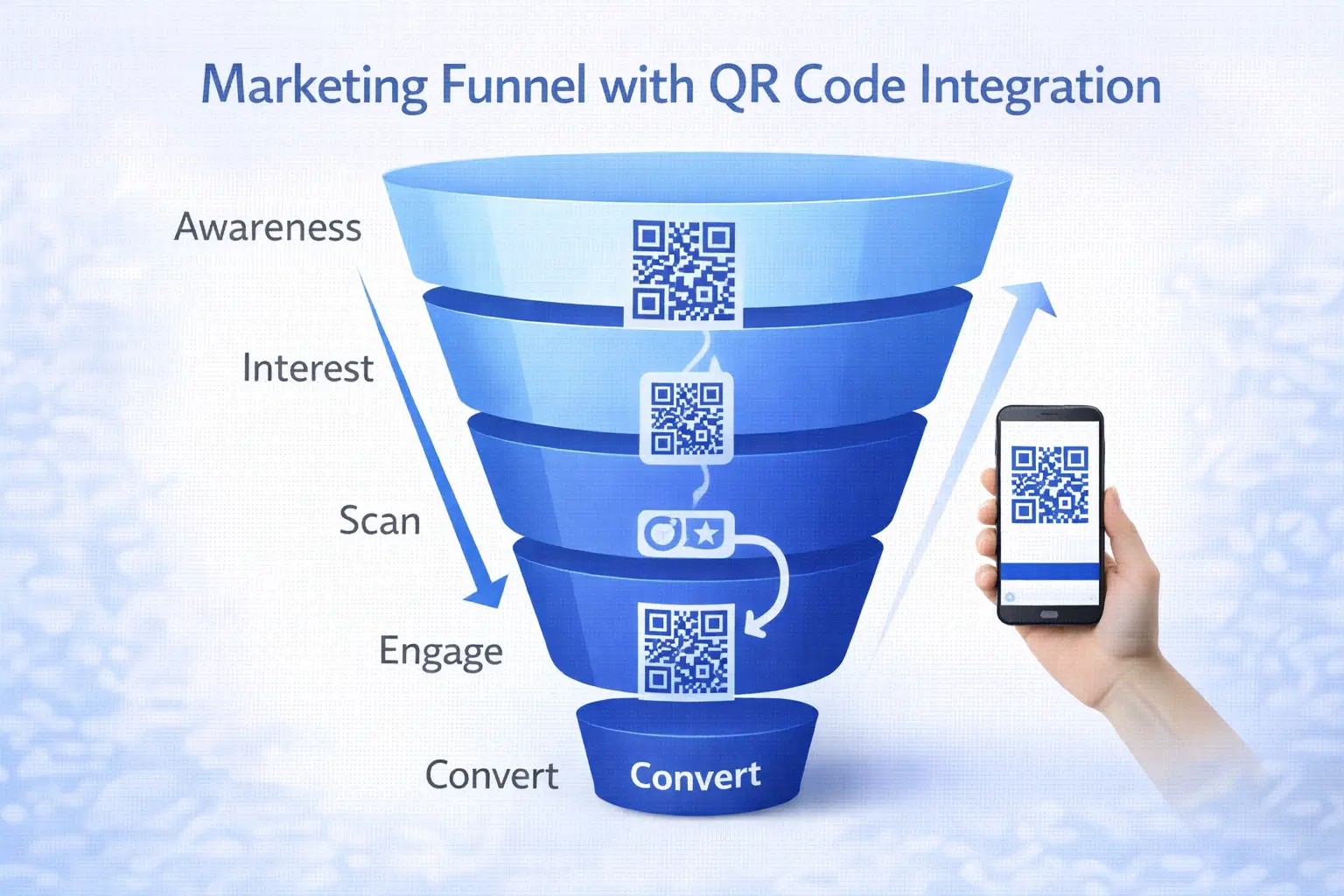
Strategic positioning: QR codes work best as bridges, not destinations. They connect a physical touchpoint (where you have attention) to a digital experience (where you can convert).
How do you plan a QR code marketing campaign?
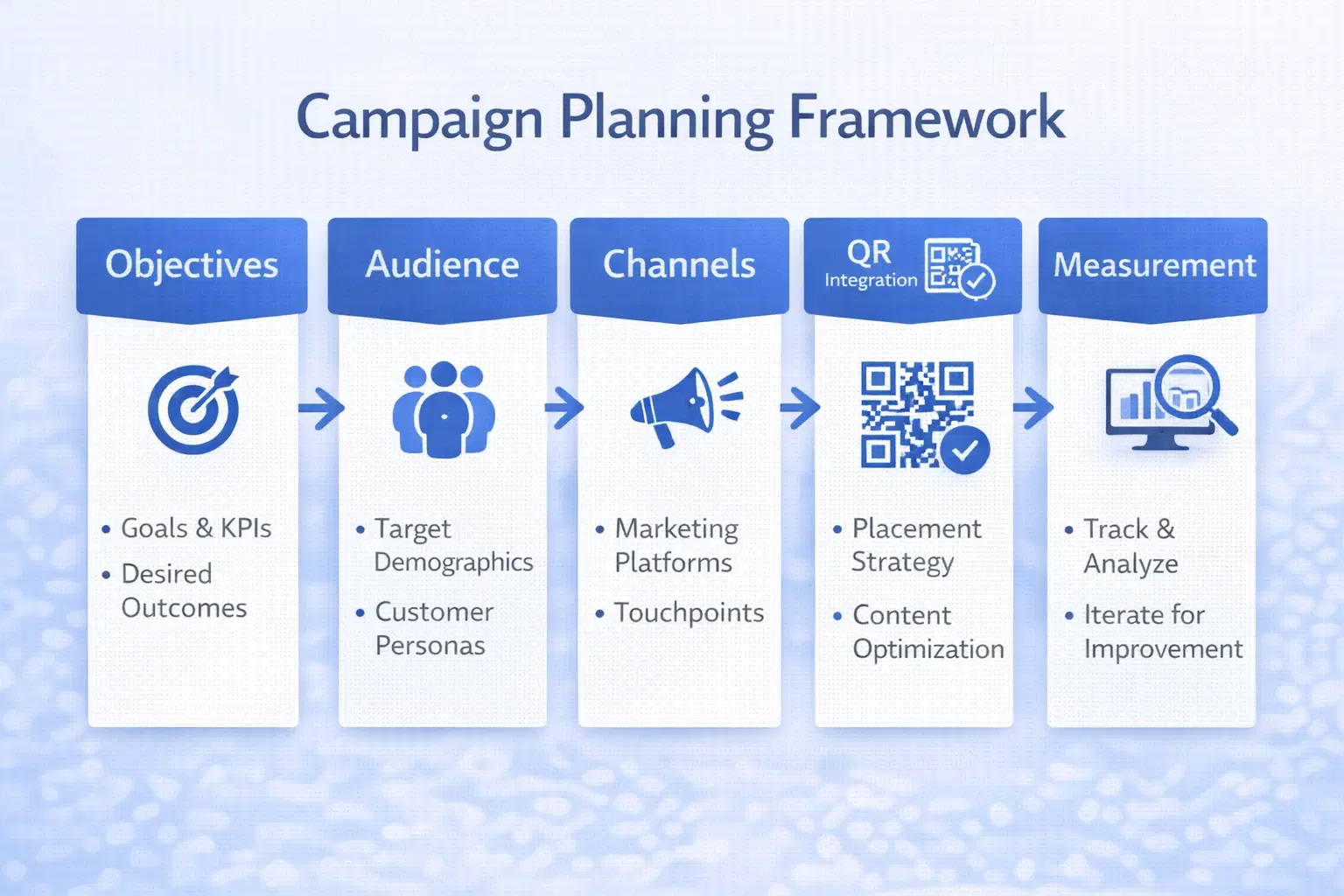
Structure your QR code campaigns for success:
Define clear objectives: What do you want to happen after the scan?
- Drive website traffic
- Capture leads/emails
- Promote offers/discounts
- Provide product information
- Enable direct purchases
- Build social following
- Collect feedback
Understand your audience:
- Are they comfortable with QR codes?
- What devices do they use?
- What motivates them to scan?
- Where will they encounter the code?
Design the user journey: 1. Attention: What draws them to the code? 2. Motivation: Why should they scan? 3. Action: What's the immediate post-scan experience? 4. Conversion: How do they complete the objective? 5. Follow-up: What happens next?
Set measurable goals:
- Specific: "Increase email signups" → "Capture 500 new emails"
- Time-bound: "During Q4 campaign period"
- Realistic: Based on traffic and conversion benchmarks
Channel-by-Channel QR Code Campaign Breakdown
Different channels call for different QR types, destinations, and success metrics. Use this as a starting map for your campaign, then layer the creative angles below it.
| Channel | Best QR Type | What to Link To | Key Metric |
|---|---|---|---|
| Print ads | Dynamic URL | Campaign landing page | Scans / print run |
| Product packaging | Dynamic URL | Reorder / how-to video | Repeat scan rate |
| Business cards | Dynamic vCard | LinkedIn / booking page | Contact saves |
| Event signage | Dynamic URL | Registration / check-in | Scans per hour |
| Email signature | Static URL | Portfolio / calendar | Click-through |
| Window clings | Dynamic URL | Google Maps / menu | Walk-in attribution |
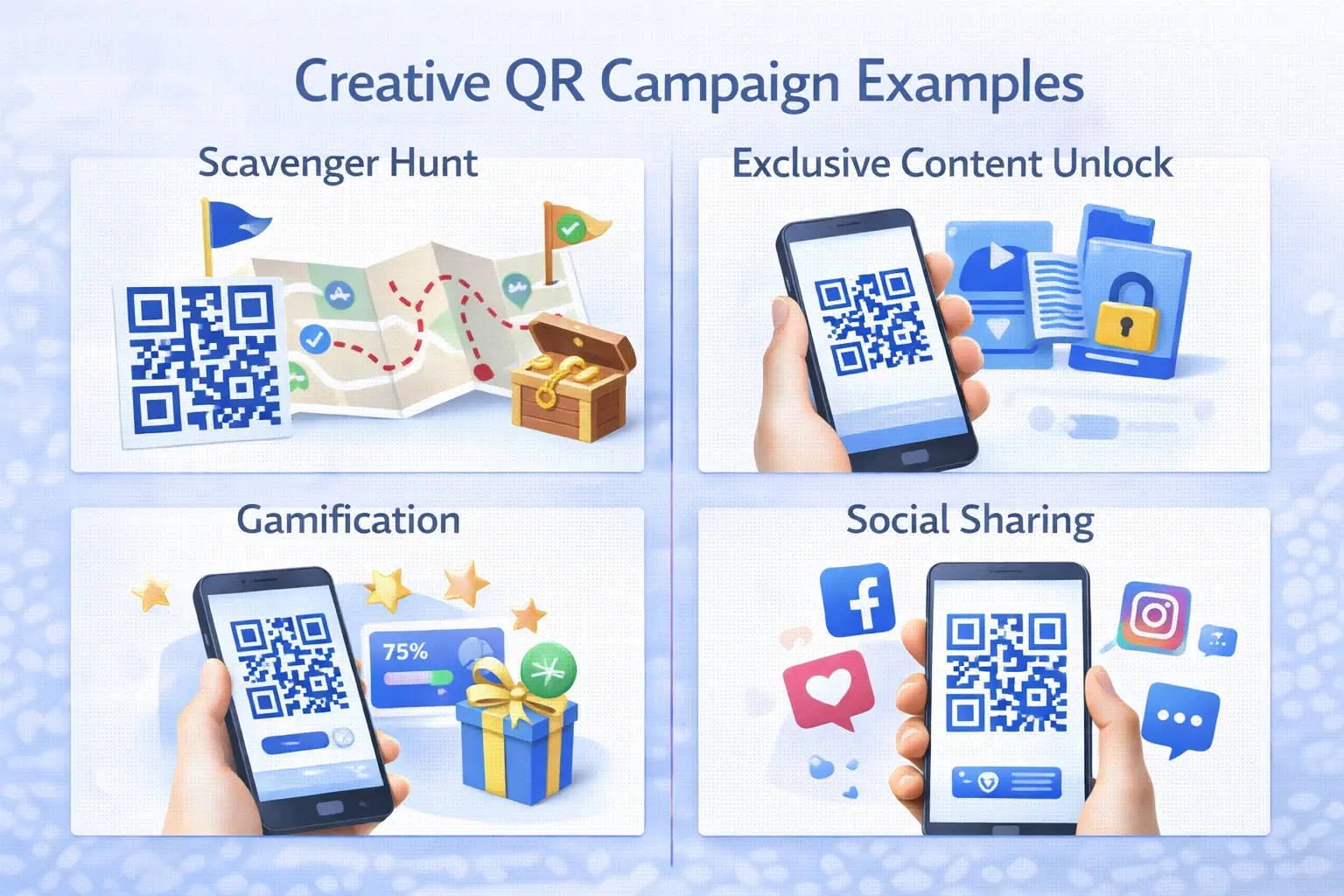
Most of these are dynamic because the destination changes over a campaign's life or you need scan data to judge the placement. Once you have the type and destination set, customize your campaign QR code with brand colors and a logo so it looks intentional rather than bolted on. Beyond picking the right type, the creative angle decides whether anyone scans at all:
Exclusive content: "Scan for behind-the-scenes footage" Creates curiosity and offers value not available elsewhere.
Limited-time offers: "Scan to unlock 20% off. Expires in 24 hours" Combines scarcity with convenience.
Interactive experiences: "Scan to play and win" Gamification drives engagement and sharing.
Product authentication: "Scan to verify authenticity" Especially effective for premium/luxury goods.
Instant utility: "Scan to add to your calendar" Immediate practical value increases scan rates.
Augmented reality: "Scan to see this product in your space" Novel experience that's highly shareable.
Social proof: "Scan to read customer reviews" Addresses purchase hesitation at point of decision.
Pro Tip
The best QR code marketing provides immediate value. Ask: "What will make someone glad they scanned?" If you don't have a compelling answer, reconsider the campaign.
Channel Integration
QR codes work best as part of integrated campaigns:
Print advertising:
- Full-page magazine ads with QR to landing page
- Newspaper ads with QR to current deals
- Catalog pages with QR to product details
Out-of-home:
- Billboards with QR (large codes, simple destinations)
- Transit ads (bus stops, subway platforms)
- Retail storefront windows
Product packaging:
- Box QR to registration/warranty
- Label QR to usage tips or recipes
- Insert card QR to exclusive content
Direct mail:
- Postcard QR to personalized landing page
- Catalog QR to "shop this look"
- Invoice QR to easy reorder
In-store:
- Shelf talkers with QR to reviews
- Display units with QR to demos
- Checkout area with QR to loyalty signup
Events:
- Badge/lanyard QR for networking
- Booth display QR for product info
- Session room QR for speaker resources
- Align QR code content with channel context
- Use unique codes for each channel to track performance
- Match destination experience to scan environment
- Ensure codes are appropriately sized for each medium
- Test in realistic conditions for each channel
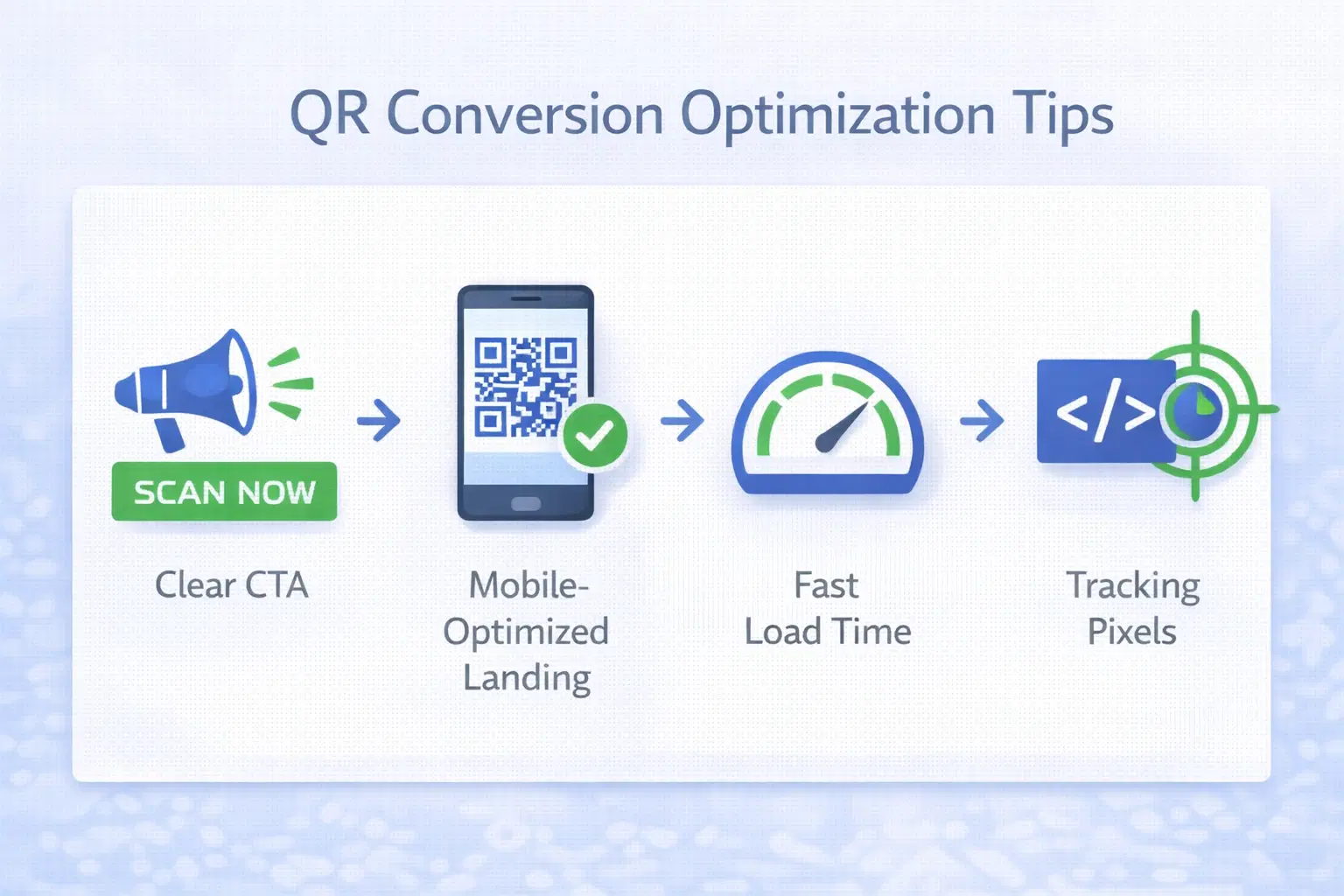
Conversion Optimization
Maximize results from every scan:
Landing page best practices:
- Mobile-first design (100% of scans are mobile)
- Sub-3-second load time
- Clear, single focus (one primary CTA)
- Minimal form fields
- Seamless experience (no login required initially)
Call-to-action optimization:
- Clear instruction: "Scan to Get Your Discount"
- Value statement: "Save 20% Instantly"
- Urgency when appropriate: "Today Only"
- Position near QR code
Form optimization:
- Progressive profiling (ask less initially)
- Auto-fill support
- Clear privacy statement
- Immediate value exchange
Follow-up strategy:
- Instant confirmation (on-page or email)
- Next steps clearly communicated
- Nurture sequence for non-converters
- Retargeting pixel for additional touchpoints
Measurement and Analytics
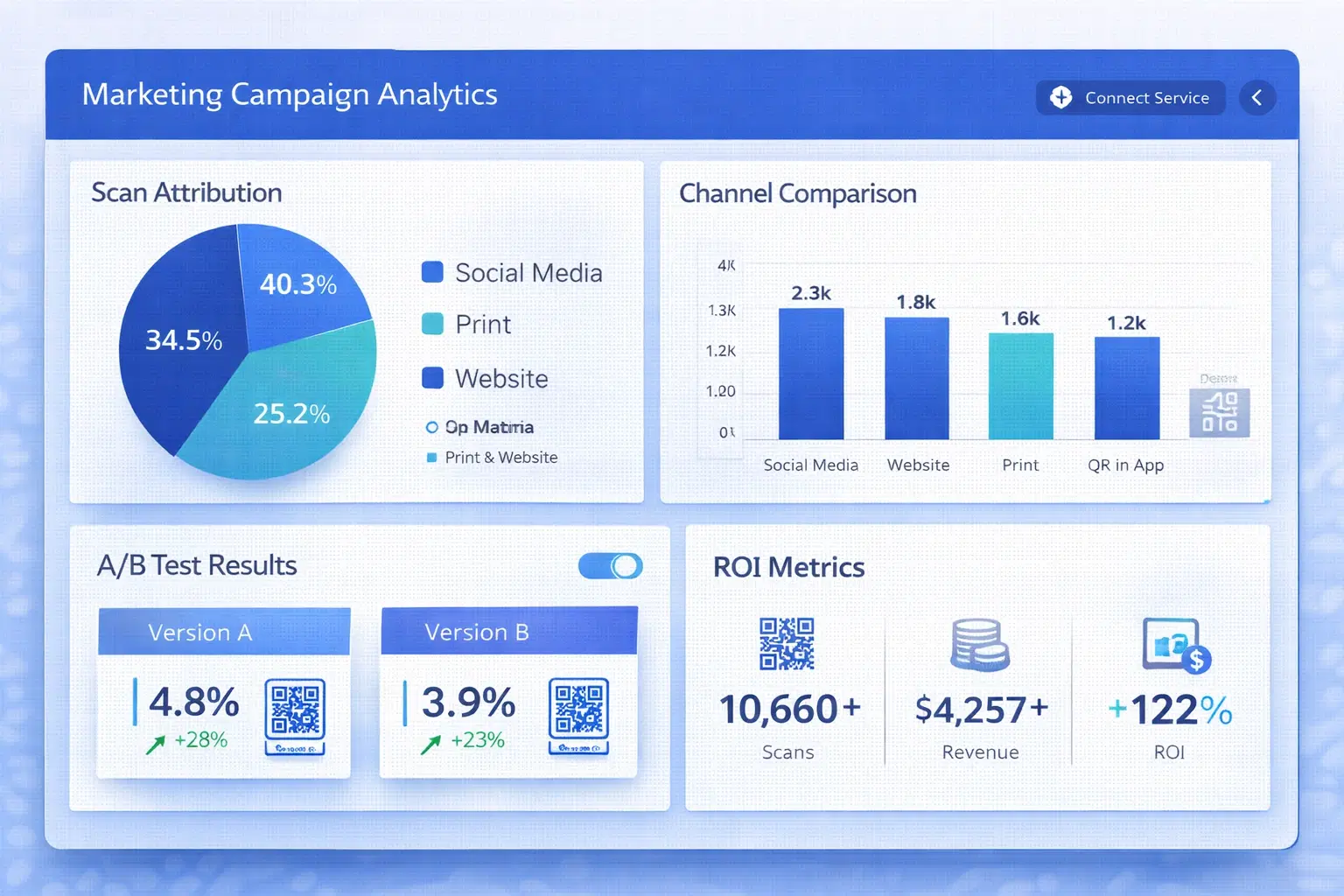
Prove ROI and optimize performance. Every campaign should be measured; see the QR code analytics guide for a breakdown of which metrics matter.
Essential metrics:
- Scan count (total and unique)
- Scan-to-visit rate
- Bounce rate on landing page
- Conversion rate
- Cost per scan
- Cost per conversion
- Revenue attributed
Attribution setup:
- Unique QR codes per placement/channel
- UTM parameters for GA tracking
- Unique promo codes for sale attribution
- Dedicated landing page URLs
Analysis framework: 1. Compare performance across placements 2. Identify high and low performers 3. Investigate root causes 4. Develop optimization hypotheses 5. Test improvements 6. Scale successes
Reporting cadence:
- Daily: During campaign launch (catch issues)
- Weekly: Ongoing campaign monitoring
- Campaign-end: Full post-mortem analysis
- Quarterly: Channel performance comparison
Budget and ROI Considerations
Make the business case for QR code marketing:
Cost components:
- QR code platform subscription (see the full QR code pricing breakdown for free vs paid tiers)
- Design and creative
- Print production
- Media placement (if applicable)
- Landing page development
- Campaign management time
ROI calculation: (Revenue Generated - Total Campaign Cost) / Total Campaign Cost × 100
Benchmarks to consider: Published scan-rate and conversion benchmarks vary widely by industry, placement, and offer, so treat any single number with caution. The reliable approach is to set your own baseline from the first campaign and improve against it, rather than chasing a quoted average. Use unique codes per placement so your benchmarks reflect your audience, not someone else's case study.
Cost comparison: QR codes often cost less per engagement than:
- Paid digital advertising
- Traditional direct mail
- Trade show lead capture
- Cold outbound marketing
Value beyond direct ROI:
- First-party data collection
- Customer insight generation
- Attribution of offline marketing
- Customer journey data
- Calculate total campaign investment
- Track all conversions attributable to QR codes
- Assign value to each conversion type
- Include value of data and insights gathered
- Compare to alternative channel costs
- Factor in lifetime value of acquired customers
Future-Proofing Your Strategy
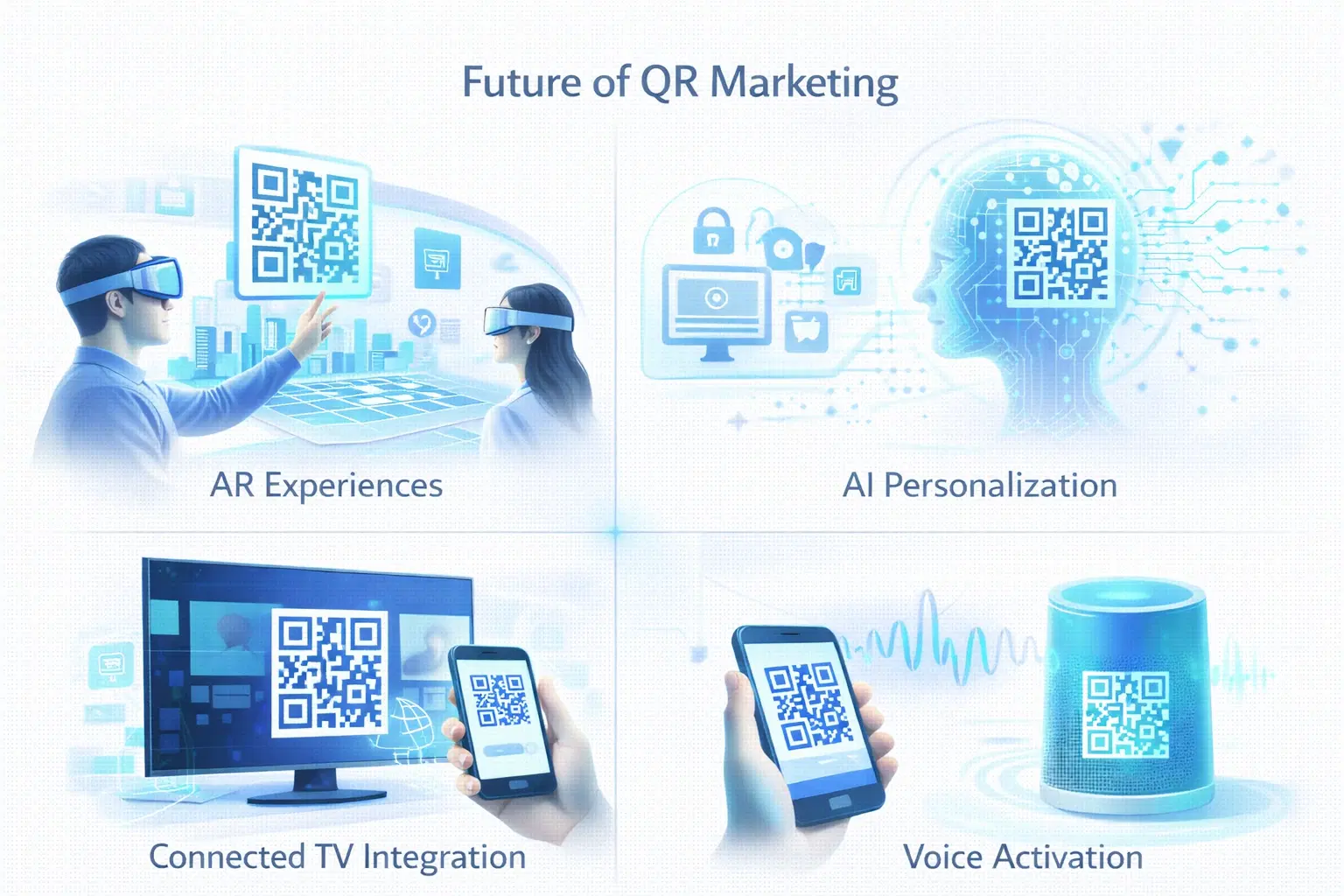
Stay ahead of QR code marketing evolution:
Emerging trends:
AR integration: QR codes increasingly launch augmented reality experiences: product visualization, try-ons, gamification.
Personalization: Dynamic codes that serve different content based on scan context: location, time, device, user history.
Payment integration: Direct-to-purchase from QR code in advertising, reducing conversion steps.
Cross-platform unification: QR codes as consistent touchpoint across all physical-digital interactions.
AI optimization: Machine learning optimizing destinations and offers based on scan patterns.
Preparing for the future:
- Build flexible infrastructure (dynamic codes)
- Invest in mobile experience capabilities
- Develop data capture and activation systems
- Stay informed on technology developments
- Test emerging applications early
Conclusion
Track every scan from your marketing campaigns with permanent, editable codes and per-channel analytics. Start a 7-day free trial, no credit card required.
QR codes have evolved from novelty to necessity in marketing. They offer something rare: measurable bridges between physical and digital experiences, with high-intent audiences and flexible, updatable content.
The 2026 marketing pattern that works: Use *per-channel* QR codes: one for direct mail, one for outdoor ads, one for trade show flyers, one for in-store signage. Each routes to the same destination but generates separate scan analytics. Within 90 days you'll know which channels are actually generating engagement and which are silently wasting budget. This is the single biggest underused tactic in QR marketing.
Success requires treating QR codes as strategic campaign elements, not afterthoughts. Plan with clear objectives, create compelling reasons to scan, optimize every step of the journey, and measure rigorously. The two disciplines that turn this from theory into results are proper measurement and continuous testing.
Related reading:
- QR Code Cost Per Scan: How to Budget a QR Campaign
- How to Track QR Codes in Google Analytics 4 (UTM Guide)
- QR Code A/B Testing: How to Test and Optimize Your Campaigns
- The Psychology of QR Code Scanning: Why People Scan (or Don't)
- How to Track QR Code Scans Without an App
- QR Code Analytics: What Data Can You Actually Track?
- How to Edit a QR Code After Printing (Without Reprinting)
- QR Code for Customer Feedback & Surveys
Build trackable QR codes for your next campaign with QRForever: permanent dynamic codes with per-channel analytics and the ability to edit destinations as your campaign evolves.
Frequently Asked Questions
What is the cost per scan for QR code campaigns?
Cost per scan is your tool subscription divided by total scans. With QRForever's Pro plan at ₹499/month, a campaign that generates 500 scans costs well under ₹499 divided across those scans, which works out to a small fraction of a rupee per scan. Higher-volume campaigns push the per-scan cost down further, which is why QR is one of the cheapest ways to attribute offline marketing.
Do QR codes still work for marketing in 2026?
Yes. Since smartphone cameras began scanning QR codes natively (no separate app needed on modern iOS and Android), scanning has become mainstream. Industry surveys report that the large majority of marketers now use QR codes in their campaigns and plan to use them more, so the format is firmly past the experimental stage.
How do I track QR code campaign performance?
Use a dynamic QR code, which logs every scan with device type, location, and timestamp. Add UTM parameters to the destination URL so scan traffic also flows into Google Analytics, and use a unique code per placement so you can compare channels. See scan analytics for what QRForever records on each scan.
What size should a QR code be on a poster?
As a rule of thumb, keep a printed code at least 2.5 cm by 2.5 cm (about 1 inch by 1 inch) for close-range scanning. For billboards and other out-of-home placements that are read from a distance, scale the code up so it stays comfortably scannable, and always test it at the real viewing distance before the run prints.
Which industries use QR codes in marketing most effectively?
Retail, restaurants, real estate, and events see the strongest results. Retail links window displays and packaging to product pages, restaurants use menu and review codes on tables, real estate puts property-detail codes on yard signs and brochures, and events use codes for check-in, agendas, and feedback. What these share is a physical touchpoint where a customer already has a phone in hand and a reason to scan.
Explore QRForever Solutions
Ready to Create Your Own QR Codes?
Start creating dynamic QR codes for your business today. Track analytics, update content anytime, and never reprint again.
Related Articles
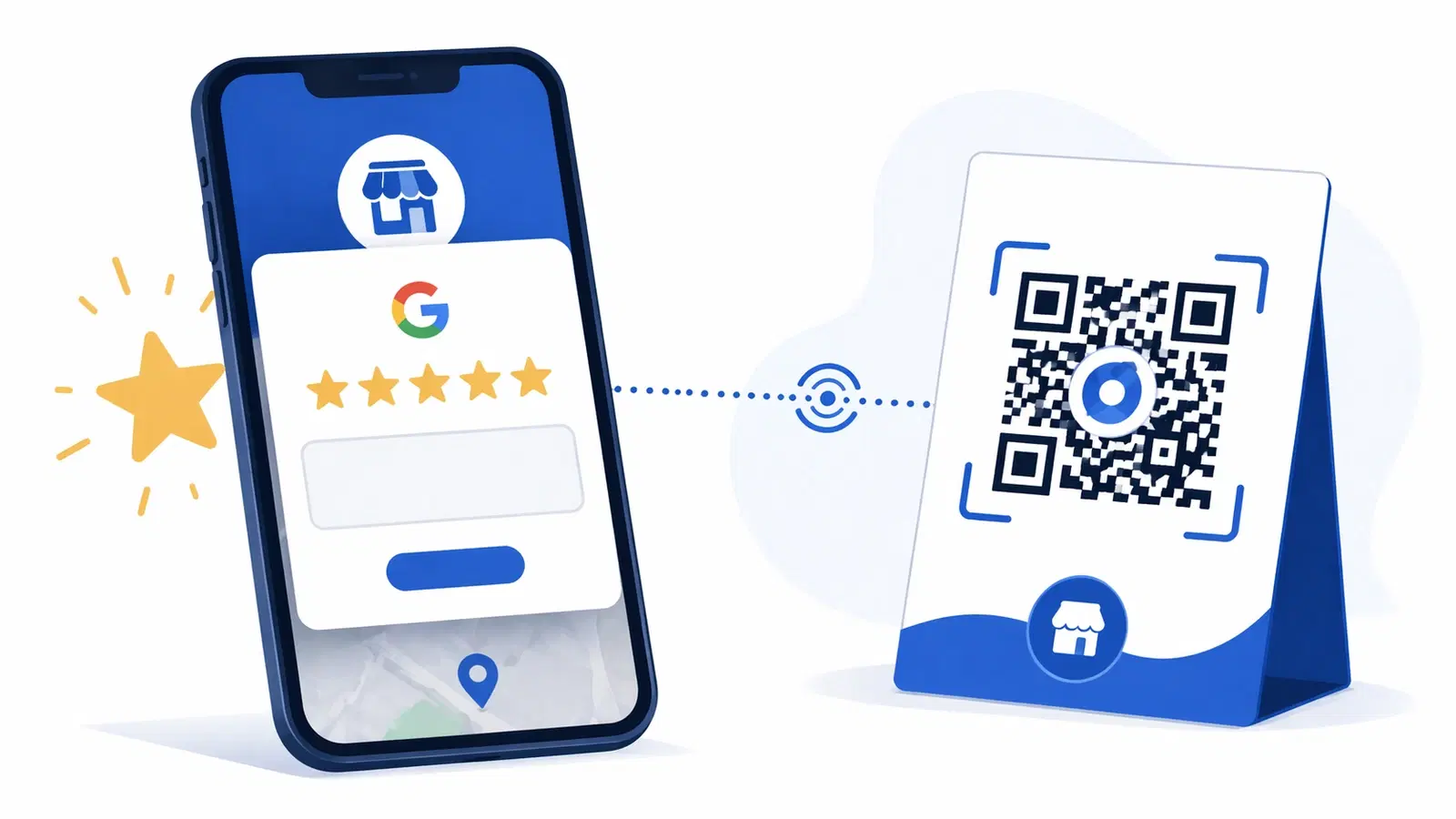
How to Create a QR Code for Google Reviews: Get More 5-Star Reviews in 2026
A Google Review QR code sends customers straight to your review page, no searching, no friction. Learn how to set it up, where to place it, and how businesses 3x their review count.
How to Create a QR Code for Your Instagram & Social Media Profiles in 2026
Link your Instagram, Facebook, YouTube, or any social profile to a QR code. Perfect for offline promotions, packaging, and events. Includes Linktree alternatives and multi-link setups.
QR Code for Customer Feedback & Surveys: Collect Reviews and Insights Instantly in 2026
A feedback QR code lets customers share opinions in 30 seconds, right after the experience. Setup guide for restaurants, retail, clinics, hotels, and any customer-facing business.