QR Code Cost Per Scan: How to Budget a QR Campaign (2026)
What does a QR code campaign actually cost per scan, and how should you budget one? Unlike ads, QR codes have a fixed cost and unlimited scans, which changes the math entirely. Here is how to think about QR campaign budgeting and cost per scan in 2026.

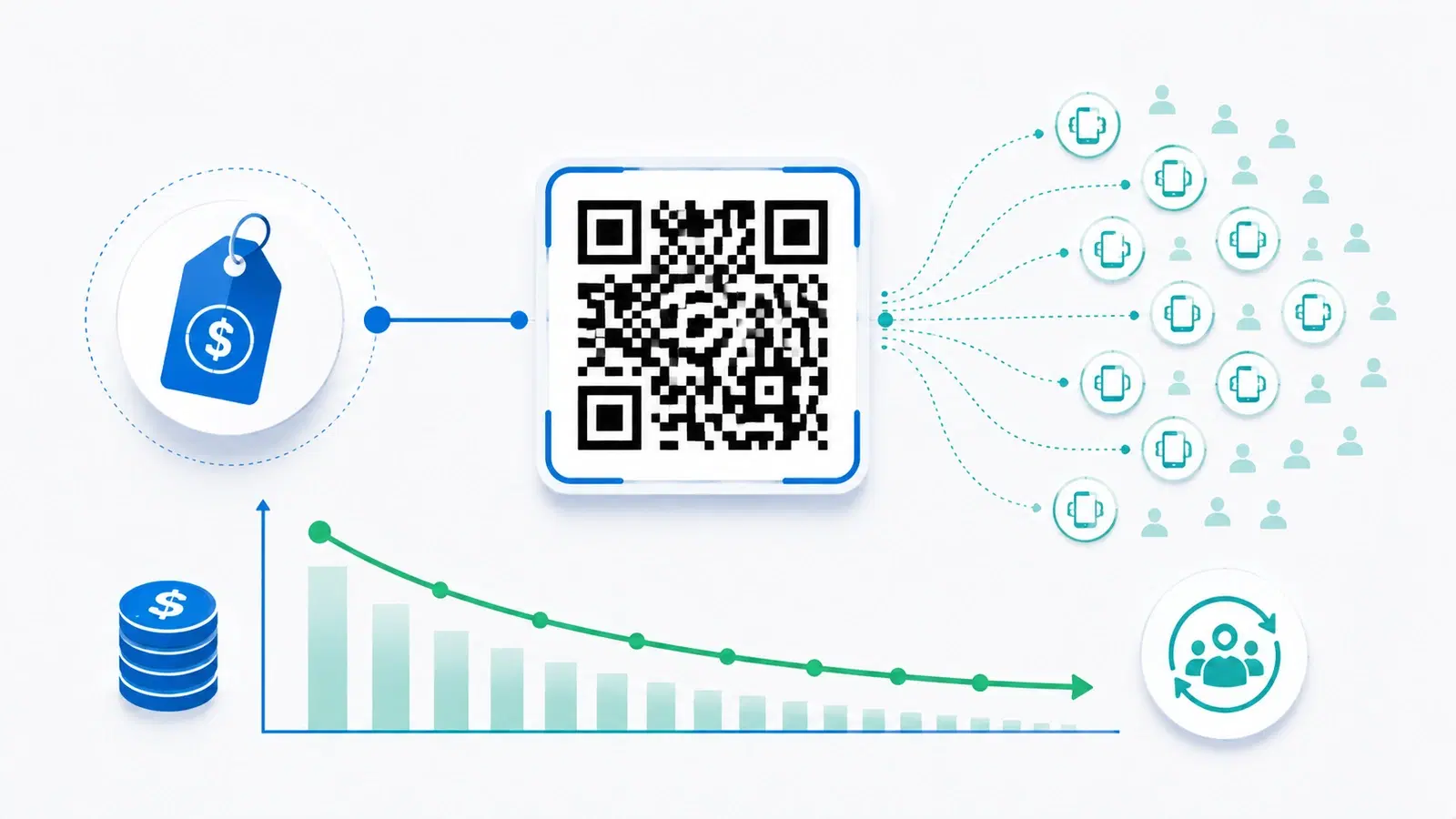
Marketers used to cost-per-click and cost-per-impression naturally ask: what is the cost per scan of a QR code campaign? It is a reasonable question, but the answer reveals something important, QR codes do not work like paid ads at all, and that difference is exactly what makes them attractive.
With most paid media, you pay per interaction: every click or impression costs money, so more engagement means more spend. A QR code flips this. You pay a fixed cost for the code (and the materials it appears on), and then it can be scanned unlimited times at no additional cost per scan. The more it is scanned, the lower your effective cost per scan drops. This is a fundamentally different, and often far better, economic model.
This guide explains how to budget a QR code campaign and think about cost per scan in 2026: why QR economics differ from ads, what actually drives the cost, how to calculate effective cost per scan, and how to judge return on investment. This is about campaign budgeting and ROI, not the price of a QR code plan itself, for that, see how much a dynamic QR code costs and the pricing comparison.
Why QR Codes Do Not Work Like Paid Ads
Understanding the economic difference is the whole foundation of budgeting a QR campaign correctly.
Paid ads: pay per interaction. In paid search or social, you pay each time someone clicks or sees your ad. Cost scales directly with engagement, more clicks, more cost. Your cost per click is set largely by an auction and competition, and it never really goes away; you pay again for every new interaction.
QR codes: pay once, scan unlimited. A QR code is different. You pay a fixed cost to create and place it, the platform subscription plus the printing or design, and after that, scans are free. Whether the code is scanned ten times or ten thousand, your cost does not change. There is no per-scan charge and no auction.
What this means for cost per scan. Because the cost is fixed and scans are unlimited, your effective cost per scan is simply your total cost divided by the number of scans, and it keeps falling as scans rise. A code that costs a fixed amount and gets scanned a lot can reach an effective cost per scan far below what any paid click would cost. The economics improve the more successful the campaign is, the opposite of paid media, where success costs more.
The strategic implication. This makes QR codes especially powerful for campaigns you expect to get sustained engagement: the model rewards longevity and volume. It also means the goal shifts from "minimize cost per interaction" (as in ads) to "maximize scans against a fixed cost," which is a more optimistic and controllable problem. For where QR fits alongside other channels, see QR codes for marketing campaigns.
What Actually Drives QR Campaign Cost
Since the model is "fixed cost, unlimited scans," budgeting means understanding what makes up that fixed cost. There are a few components.
1. The platform cost. Your QR code platform subscription. This is usually modest relative to a campaign and covers dynamic codes, the ability to edit destinations, and analytics. It is a fixed, predictable cost regardless of scan volume. Choose a plan sized to your needs; see the pricing comparison.
2. The physical placement cost. This is usually the largest part: printing and placing the code. Flyers, posters, packaging, signage, table tents, whatever carries the code. This cost depends on your print run and materials, not on scans. A code on a million packages costs more to place than one on a single poster, but neither costs more when scanned.
3. The design and creative cost. Designing the code and the material it sits on, and building the landing page it points to. A one-time creative cost. The landing page matters enormously, since it determines whether scans convert.
4. What is NOT a cost: the scans themselves. The key point again, scans add nothing. Unlike ad spend, there is no meter running as people engage.
The budgeting takeaway. To budget a QR campaign, you are really budgeting the fixed inputs: platform, print/placement, and creative. Once those are set, your cost is capped, and every additional scan only improves your return. This predictability is a real advantage: unlike an ad campaign that can overspend, a QR campaign's cost is largely fixed and known in advance.
- Platform subscription: modest, fixed, includes dynamic codes and analytics
- Print and placement: usually the largest cost, depends on run size not scans
- Design and creative: one-time cost for the code, materials, and landing page
- Scans themselves: free, no per-scan charge no matter the volume
- Net effect: cost is largely fixed and known upfront, unlike ad spend
Calculating Your Effective Cost Per Scan
Even though there is no per-scan charge, calculating an effective cost per scan is useful for comparing QR to other channels and judging performance.
The simple formula. Effective cost per scan = total campaign cost divided by total scans. Add up your fixed costs (platform + print/placement + creative), then divide by the number of scans the campaign generates. That is your real cost per scan.
Why it keeps improving. Because the numerator (total cost) is fixed and the denominator (scans) grows over time, your effective cost per scan continuously falls as the campaign runs. A campaign that has been live longer, or performs well, has a lower effective cost per scan than the same campaign on day one. This is why QR codes reward patience and longevity.
The dynamic-code advantage here. Using a dynamic code improves this math further. Because you can change the destination without reprinting, one printed code can serve multiple campaigns over its life. The fixed print cost is amortized across everything you ever point it at, driving the long-run cost per scan even lower. A static code, by contrast, is locked to one use and cannot be repurposed.
Comparing to paid channels. Once you have an effective cost per scan, you can compare it to your cost per click or per visit from paid channels. Because QR scans are free after the fixed cost, a well-scanned QR campaign often reaches a dramatically lower effective cost per engaged visitor than paid media, especially over time. Just compare fairly: a scan is an engaged, intentional action, often higher-quality than a passive impression.
Measure it properly. To calculate any of this, you need scan data, which means dynamic codes with analytics. Track scans over time and by placement so you know your real numbers rather than guessing. See what analytics can track and tracking QR codes in GA4.
Pro Tip
Because a dynamic code can be repointed to new campaigns without reprinting, calculate cost per scan over the code's whole life, not just one campaign. A single well-placed permanent code reused across several campaigns spreads its fixed print cost across all of them, pushing the true long-run cost per scan far lower than a one-and-done static code ever could.
Budgeting a Campaign and Judging ROI
Putting it together, here is how to budget a QR campaign and evaluate whether it paid off.
Budgeting steps: 1. Set your fixed costs. Decide your platform plan, your print run and materials, and your creative/landing-page investment. These define your total, capped cost. 2. Estimate scan potential. Based on placement, audience, and reach, estimate a realistic scan range. You do not pay per scan, so this is about forecasting value, not cost. 3. Invest in the destination. Since scans are free but conversions are the goal, put real effort into the landing page. A great page turns free scans into results. 4. Use dynamic codes. So you can track performance and optimize the destination mid-campaign without reprinting. See A/B testing QR campaigns.
Judging ROI:
- Track scans and conversions, not just scans. A scan is engagement; what matters is what happens after, sign-ups, sales, leads. Measure the outcomes the campaign was meant to drive.
- Calculate return against the fixed cost. Because your cost is capped and known, ROI is straightforward: the value generated (conversions, revenue, leads) against your fixed campaign cost. As scans and conversions accumulate over time, ROI improves.
- Credit the long tail. Unlike an ad that stops the moment you stop paying, a printed QR code keeps working, and keeps generating scans and value, long after launch, at no additional cost. Factor that ongoing return into your evaluation.
The bottom line on budgeting. QR campaign budgeting is refreshingly predictable: fixed, known costs; free, unlimited scans; and returns that grow over time. The discipline is not in controlling per-scan spend (there is none) but in investing wisely in the fixed inputs, especially the landing page, and in measuring outcomes so you know the real return.
Conclusion
The question "what is a QR code's cost per scan" has a liberating answer: nothing, per scan. You pay a fixed cost to create and place a code, then it can be scanned unlimited times for free, so your effective cost per scan only falls as the campaign runs. This is the opposite of paid advertising, where every interaction costs more, and it is what makes QR codes so economically attractive for campaigns with sustained engagement.
Budgeting a QR campaign therefore means budgeting the fixed inputs, platform, print and placement, and creative, rather than a per-interaction meter. Calculate effective cost per scan as total cost divided by scans, use dynamic codes so one printed code can serve many campaigns and drive that number even lower, and compare fairly against paid channels, remembering a scan is an intentional, engaged action.
Judge ROI on outcomes, scans that convert to sign-ups, sales, and leads, against your fixed, known cost, and credit the long tail of scans a printed code keeps earning for free long after launch. Budget the inputs well, invest in the destination, measure the outcomes, and QR codes deliver a cost structure most channels cannot match.
Related reading:
Run a trackable QR campaign with QRForever. Start a 7-day full-access trial, no credit card needed. Fixed cost, unlimited scans, and analytics to prove your ROI.
Explore QRForever Solutions
Ready to Create Your Own QR Codes?
Start creating dynamic QR codes for your business today. Track analytics, update content anytime, and never reprint again.
Related Articles
QR Code Marketing Strategy: 15 Campaign Types That Work in 2026
A practical QR code marketing playbook: 15 campaign types with real examples, a channel-by-channel breakdown, attribution setup, and the mistakes that quietly waste budget. Updated June 2026.
How to Create a QR Code for Google Reviews: Get More 5-Star Reviews in 2026
A Google Review QR code sends customers straight to your review page, no searching, no friction. Learn how to set it up, where to place it, and how businesses 3x their review count.
How to Create a QR Code for Your Instagram & Social Media Profiles in 2026
Link your Instagram, Facebook, YouTube, or any social profile to a QR code. Perfect for offline promotions, packaging, and events. Includes Linktree alternatives and multi-link setups.