QR Code A/B Testing: How to Test and Optimize Your Campaigns (2026)
Most QR campaigns are launched once and never improved. A/B testing changes that: run two versions, measure which wins, and keep improving. Here is how to A/B test QR codes properly, from what to test to how to read the results.

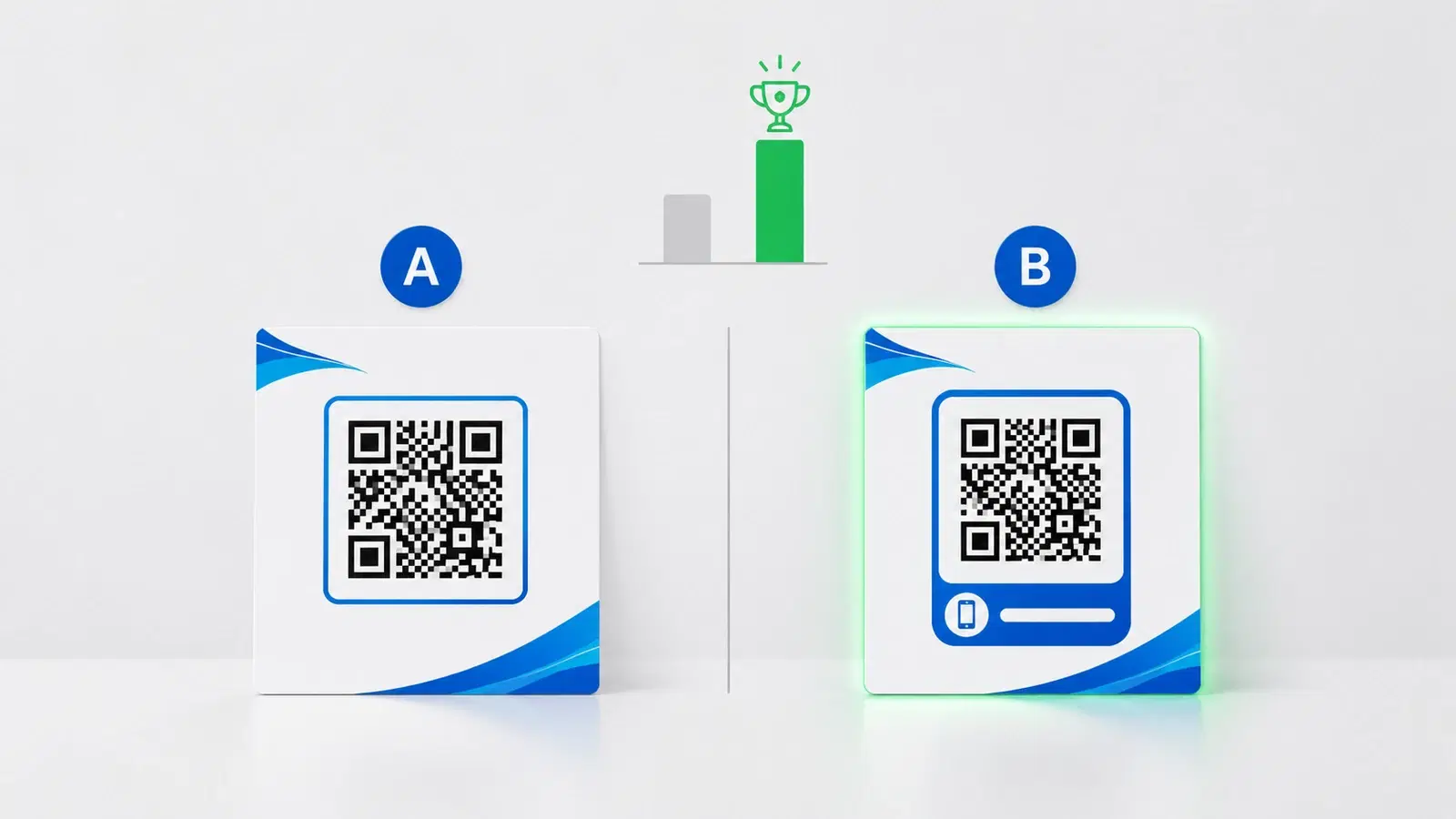
Most QR code campaigns are launched once, based on someone's best guess about the design, the wording, and the placement, and then never touched again. That is a missed opportunity, because small changes to any of those can meaningfully change how many people scan and how many convert.
A/B testing is the discipline of not guessing. Instead of debating whether "Scan for our menu" or "Scan for tonight's specials" works better, you run both, measure which one actually performs, and keep the winner. Over a few rounds, this turns a mediocre campaign into a good one, using evidence rather than opinion.
This guide explains how to A/B test QR codes properly: what is worth testing, how to set up a fair test, how to measure results using your QR analytics and GA4, and how to read the outcome without fooling yourself. It builds directly on our GA4 tracking guide, since proper testing depends on proper measurement.
What A/B Testing Actually Means for QR Codes
A/B testing is comparing two versions of something to see which performs better, by showing each to a portion of your audience and measuring the result.
Applied to QR codes: You create two variants that differ in one thing (the call to action, the design, the placement, or the destination), deploy both, and measure which gets more scans or, more importantly, more conversions. The better performer becomes your new standard, and then you test again to improve further.
The two levels you can test:
- Scan rate: what makes more people scan the code in the first place. This is mostly about the call to action, the design, and the placement, all of which are physical and visible before the scan.
- Conversion rate: what makes more scanners complete your goal after landing. This is about the destination page, since that is what they experience after scanning.
Both matter, and they are different. A change can lift scans but hurt conversions, or vice versa, which is exactly why you measure rather than assume.
The core principle: change one thing at a time. If you change the call to action and the design and the destination all at once, and performance changes, you have no idea which change caused it. A clean test changes one variable and holds everything else constant, so the result actually tells you something.
Why this matters for QR specifically: QR campaigns often involve printed materials that are expensive to produce and hard to change once distributed. Testing before committing to a large print run, or testing on a small deployment before scaling, saves you from printing thousands of the worse-performing version. The dynamic nature of good QR codes makes some of this testing much easier, as we will see.
What to Test (Highest Impact First)
Not everything is worth testing. Focus on the variables that tend to move the numbers most.
1. The call to action (usually the biggest lever). The text next to the code is often the single most impactful thing. Test specific against vague, benefit against instruction:
- "Scan me" versus "Scan for tonight's specials"
- "Learn more" versus "Scan for 15% off your first order"
- "Our menu" versus "See the full menu with photos"
Specific, benefit-led wording almost always wins, but the size of the win, and which specific benefit resonates, is worth measuring. See the psychology of QR code scanning.
2. Placement. Where the code sits can matter more than anything about the code itself. Test the same code in different positions: the table tent versus the menu versus the receipt, the top of the poster versus the bottom, the entrance versus the counter. Placement affects both whether people notice it and whether they have a moment to scan.
3. The destination page. For conversion, the landing page is decisive. Test different versions: a direct product page versus a landing page, a page with the offer front and center versus one that buries it, a short form versus a long one. This is where GA4 measurement earns its keep.
4. Design. Once the bigger levers are tuned, design can be tested: framed versus unframed, different colors, with logo versus without, different sizes. Design usually matters less than call to action and placement, so test it after those.
5. The offer itself. Sometimes the biggest lever is what you are offering. Test different incentives: a discount versus free shipping versus bonus content. This blurs into general marketing testing, but the QR code is a clean way to run it in the physical world.
Where to start: If you test nothing else, test the call to action. It is the cheapest to change, and it usually moves the scan rate most.
- Call to action: specific and benefit-led vs vague (usually the biggest lever)
- Placement: same code, different positions and contexts
- Destination page: what converts scanners after they land
- Design: framed, colored, logo, size (test after the bigger levers)
- The offer: different incentives entirely
How to Run a Fair QR Code A/B Test
A test is only useful if it is fair. Here is how to set one up so the result means something.
Method 1: Two codes, split by placement or time. Create two QR codes, each with its own UTM tags (utm_content=version_a and utm_content=version_b), pointing to whatever you are testing. Then split them:
- By placement: version A on half your tables or half your posters, version B on the other half, in comparable locations.
- By time: version A this week, version B next week, if conditions are otherwise similar.
Measure scans on each code (from your QR platform) and conversions (from GA4, via the UTM tags).
Method 2: Same code, different destination (for destination tests). To test only the landing page, keep everything physical identical and point the same code at different page versions for different periods, or use a testing tool on the destination. Because the code and its context are unchanged, any difference in conversion is due to the page. Dynamic codes make this easy, since you can change the destination without touching the printed code. See how to edit a QR code after printing.
The rules that keep it fair:
Change one variable. Everything except the thing being tested must be identical. Same offer, same design, same audience, if you are testing placement. Otherwise you cannot attribute the result.
Give it enough volume and time. A test with ten scans tells you nothing. Small numbers are dominated by chance. Wait until each version has a reasonably large number of scans and, ideally, conversions before drawing conclusions. What counts as enough depends on your traffic, but more is more reliable.
Test comparable conditions. If version A is on the busy front tables and version B is in the quiet corner, you are testing table location, not your variable. Split fairly.
Do not peek and stop early. Resist declaring a winner the moment one version pulls ahead. Early leads reverse constantly with small samples. Decide roughly how long or how many scans you will run before you look, and hold to it.
Important
The most common A/B testing mistake is calling a winner too early on too little data. With small numbers, random chance easily makes one version look better when it is not, and acting on that noise is worse than not testing at all. Let the test run to a reasonable volume before you trust the result.
Reading Results and Building a Testing Habit
Interpreting results honestly, and turning testing into a routine, is what compounds into real improvement over time.
Measure the metric that matters. Decide upfront what you are optimizing. If it is scans, compare scan counts. If it is conversions, compare conversions, not scans, because a version can win on scans and lose on conversions. Usually conversions matter more, since a scan that does nothing is not valuable.
Look at the full funnel. The richest reading compares both levels: did version A get more scans, more conversions, or both? The interesting cases are the splits. If version A got more scans but fewer conversions, its call to action was more appealing but attracted less qualified interest, or its destination underdelivered on the promise. That teaches you something specific.
Account for chance. A small difference on modest numbers may be noise. A large, consistent difference on good volume is signal. You do not need formal statistics for most practical marketing tests, but you do need the judgment to distinguish "clearly better" from "slightly ahead so far."
Keep the winner, then test again. The point of A/B testing is that it never really ends. You test the call to action, keep the winner, then test placement, keep the winner, then test the destination. Each round locks in an improvement and sets up the next. This is how a campaign gets genuinely optimized rather than launched-and-forgotten.
Document what you learn. Keep a simple record: what you tested, what won, by how much. Over time this becomes a playbook specific to your business and audience. You will notice patterns, like which kinds of calls to action consistently work for your customers, that transfer to future campaigns.
The mindset shift: A/B testing replaces "I think this design is better" with "the data says this call to action converts 30 percent better." That shift, from opinion to evidence, is the whole value. It is also what makes the difference between a marketer who guesses and one who compounds small, proven improvements into a campaign that genuinely works.
Testing depends entirely on measurement, so if you have not set up proper tracking yet, start there with our GA4 tracking guide.
Conclusion
A QR code campaign launched once and never improved is leaving performance on the table. A/B testing is how you stop guessing and start improving: run two versions that differ in one thing, measure which wins on the metric that matters, keep the winner, and test again.
The highest-impact things to test are the call to action first (usually the biggest lever), then placement, then the destination page for conversion. Run fair tests by changing one variable at a time, splitting comparably, gathering enough volume, and resisting the urge to call a winner early. Read results by focusing on conversions over scans, watching the full funnel, and distinguishing genuine signal from small-sample noise.
Do this as a habit rather than a one-off, and each round locks in a proven improvement. Over time, evidence-based iteration turns a guessed-at campaign into one that demonstrably works, and builds you a playbook of what actually resonates with your specific audience. The businesses that test consistently pull steadily ahead of the ones that launch and forget.
Related reading:
Create trackable dynamic QR codes with QRForever. Start a 7-day full-access trial, no credit card needed. Dynamic destinations and scan analytics make A/B testing straightforward.
Explore QRForever Solutions
Ready to Create Your Own QR Codes?
Start creating dynamic QR codes for your business today. Track analytics, update content anytime, and never reprint again.
Related Articles
QR Code Marketing Strategy: 15 Campaign Types That Work in 2026
A practical QR code marketing playbook: 15 campaign types with real examples, a channel-by-channel breakdown, attribution setup, and the mistakes that quietly waste budget. Updated June 2026.
How to Create a QR Code for Google Reviews: Get More 5-Star Reviews in 2026
A Google Review QR code sends customers straight to your review page, no searching, no friction. Learn how to set it up, where to place it, and how businesses 3x their review count.
How to Create a QR Code for Your Instagram & Social Media Profiles in 2026
Link your Instagram, Facebook, YouTube, or any social profile to a QR code. Perfect for offline promotions, packaging, and events. Includes Linktree alternatives and multi-link setups.