QR Codes for Franchises & Multi-Location Brands (2026)
Running QR codes across dozens or hundreds of locations is a different challenge from a single shop: brand consistency, per-location tracking, and central control all matter. Here is how franchises and multi-location brands should use QR codes in 2026.

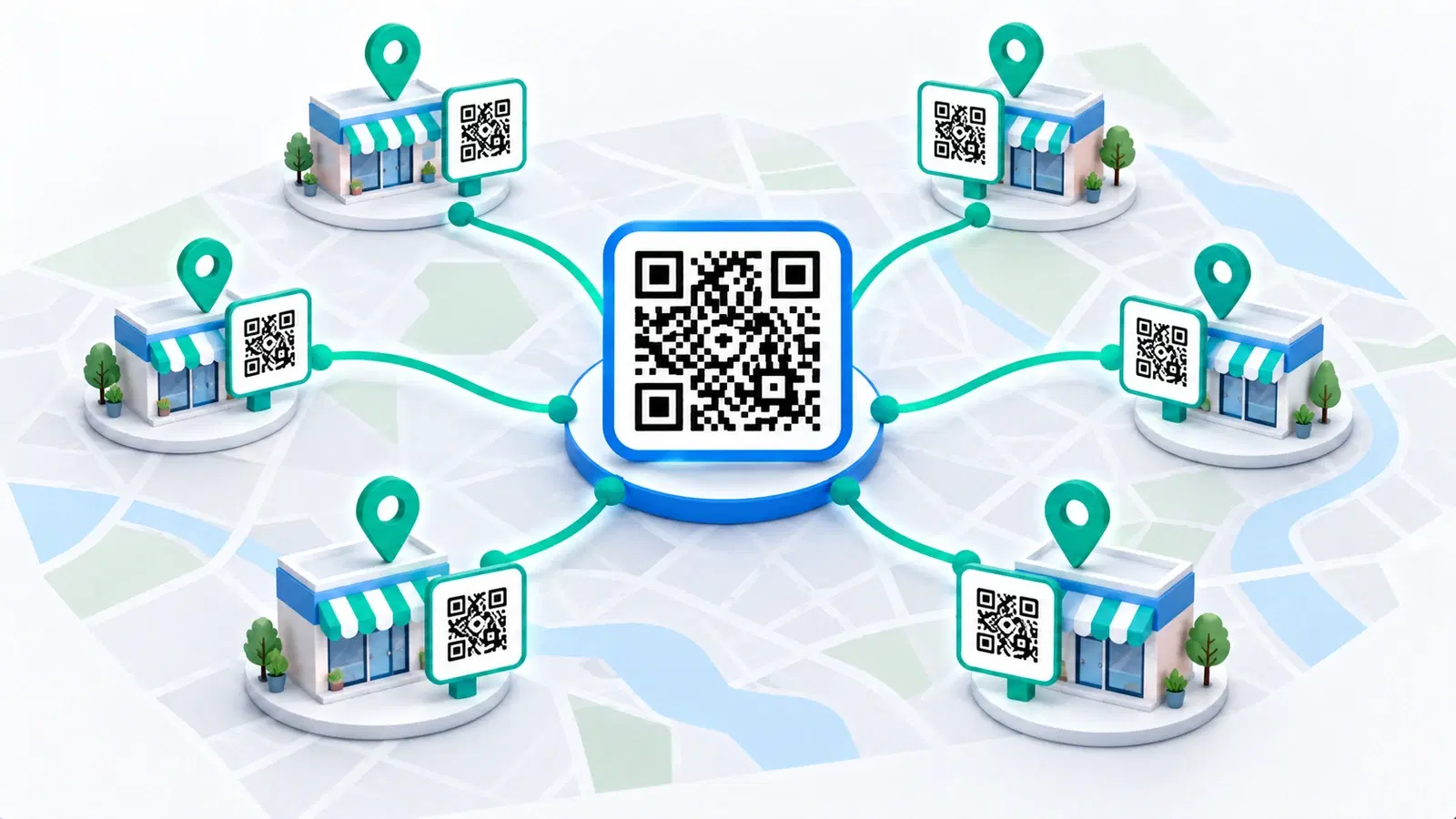
Using QR codes for one location is simple. Using them across a franchise or a multi-location brand, dozens or hundreds of stores, is a different problem entirely. Suddenly you are juggling brand consistency across every location, the need to know which location drove which scans, central control so head office is not at the mercy of each site making its own codes, and the ever-present risk of "shadow codes" that individual locations create on random free tools.
Get this right and QR codes become a powerful, measurable channel across your whole footprint: consistent branding everywhere, per-location performance data, and central control with local flexibility. Get it wrong and you end up with a chaotic mix of off-brand, untracked, unmanaged codes that nobody can account for, some of which will quietly expire and break.
This guide is specifically about the multi-location challenge: brand consistency, per-location tracking, central management, and avoiding shadow codes. It sits between the single-location small business guide and the enterprise solutions guide; here we focus on the particular needs of franchises and chains.
The Multi-Location Challenge
First, understand why QR codes at scale across locations are harder than for a single site. Naming the challenges points to the solution.
Brand consistency across every location. When each location makes its own codes, you get a mess: different styles, off-brand colors, some with logos and some without, some on third-party domains. A brand's codes should look and behave consistently everywhere. Without central control, they will not. See design and branding.
Knowing which location drove what. A single code shared across all locations tells you nothing about where scans happened. For a multi-location brand, per-location data, which store, region, or franchisee is driving scans and results, is essential for understanding performance and allocating effort. That requires distinct, tracked codes per location.
Central control vs local flexibility. Head office needs oversight and the ability to manage codes centrally (and fix or update them), while locations may need some flexibility for local campaigns. Balancing central control with local autonomy is a core multi-location challenge.
The shadow-code problem. This is the big risk. Left to their own devices, individual locations will create codes on whatever free tool they find, off-brand, untracked, unmanaged, and prone to expiring. These "shadow codes" undermine brand consistency and data, and when they break, it reflects on the brand. A central system exists largely to replace this chaos with control.
The scale factor. With many locations and many codes, you also need efficient ways to create and manage codes in bulk rather than one at a time. See bulk QR generation.
Every one of these points to the same answer: a centrally-managed, consistent, per-location-trackable QR system, which the rest of this guide describes.
Per-Location Tracking Done Right
The ability to know exactly which location drove which scans is one of the biggest wins of doing multi-location QR codes properly. Here is how to set it up.
Give each location its own code(s). Rather than one shared code everywhere, create distinct codes per location. Each location's code can point to the same experience (or a location-specific one), but because it is a separate dynamic code, its scans are tracked separately. Now you can see performance location by location.
What per-location data unlocks:
- Compare locations - which stores drive the most engagement, and which lag.
- Measure local campaigns - run a promotion at specific locations and measure its scans directly.
- Allocate effort and budget - invest where the data shows traction.
- Give franchisees their own numbers - each location or franchisee can see their own performance, which drives engagement and accountability.
See what analytics can track and, for campaign-level measurement, QR code campaign analytics.
Use dynamic codes for flexibility. Because each location's code is dynamic, head office can update where any location's code points without reprinting, useful for rolling out a new campaign across all locations at once, or fixing a single location's destination. See dynamic vs static.
Organize codes by location. With many location codes, organization is essential. A system that lets you group and label codes by location, region, or franchisee keeps everything findable and manageable, rather than a flat, unmanageable list. This is where team/workspace features matter (next section).
Consider bulk creation. For a large rollout, creating a code per location by hand is impractical. Bulk generation (from a spreadsheet of locations) lets you mint all the location codes at once. See bulk QR generation.
- Give each location its own distinct dynamic code (not one shared code)
- Compare performance location by location, and measure local campaigns
- Let each franchisee see their own numbers, driving accountability
- Use dynamic codes so head office can update destinations without reprinting
- Organize codes by location/region, and bulk-create them for large rollouts
Central Control and Brand Consistency
The other half of multi-location QR success is central management: keeping everything on-brand and under control while giving locations appropriate access.
Manage everything from one place. Head office should manage the brand's codes from a single account or system, rather than codes being scattered across individual location logins. This is what makes consistency and oversight possible. See QR codes for teams and workspaces.
Use roles to balance control and flexibility. Team features with roles let head office keep control while granting locations appropriate access: admins at head office manage everything; locations or franchisees might have limited access to their own codes and data (viewer or restricted editor). This gives central control with local visibility, without letting every location change everything.
Enforce brand consistency. Central management lets you ensure every location's codes follow brand standards, consistent design, colors, and logo, and ideally all running on your own brand domain rather than a third party's. This makes the brand look coherent and trustworthy everywhere. See white-label QR codes for running codes on your own domain.
Kill the shadow-code problem. The most valuable outcome of central control is eliminating shadow codes. When head office provides locations with proper, on-brand, tracked codes through a central system, locations no longer need to make their own on random tools. You replace chaos with a managed system, which protects both brand and data.
Clean onboarding and offboarding of locations. As locations join or leave (a real thing for franchises), a central system lets you add or remove their codes and access cleanly, without disruption. The brand owns its codes, not individual franchisees, so a departing location does not take the codes with it.
The control payoff: Central management turns a potential mess into an asset: consistent branding everywhere, all codes accounted for, per-location data flowing to one place, and the ability to act across the whole footprint at once. That is the difference between QR codes as a liability and QR codes as brand infrastructure.
Pro Tip
The highest-value move for any multi-location brand is to give every location proper, on-brand, tracked codes from a central system, so they never need to make their own. Shadow codes (locations using random free tools) are the root of most multi-location QR chaos: off-brand, untracked, and prone to expiring. Provide the codes centrally and the problem disappears.
Practical Rollout and Use Cases
Here is how to actually roll QR codes out across a multi-location brand, and where they deliver the most value.
A sensible rollout approach: 1. Set brand standards for how codes look and behave (design, domain, naming). 2. Choose a central platform with team/workspace features, per-location tracking, bulk creation, and permanence. See how to choose a generator. 3. Create location codes centrally, ideally in bulk, organized by location/region, all dynamic and on-brand. 4. Grant locations appropriate access to their own codes and data via roles. 5. Distribute the codes to locations for their materials, with guidance on placement. 6. Monitor centrally, review per-location performance, and act across the footprint as needed.
High-value multi-location use cases:
- Consistent menus, catalogs, or info across all locations, updatable centrally (one edit updates every location, or each location's own version).
- Location-specific landing pages - each code leads to that location's hours, offers, or booking.
- Reviews and feedback per location - route each location's code to its own review or feedback destination, so you can track and improve location by location. See Google reviews.
- Brand-wide campaigns with per-location measurement - run one campaign everywhere, but see which locations drove it.
- Local promotions - specific locations run targeted offers, measured individually.
The bottom line for franchises and chains: Done centrally and consistently, QR codes give a multi-location brand something powerful: a coherent, on-brand presence everywhere, granular per-location data, central control with local flexibility, and no shadow-code chaos. Treat QR codes as managed brand infrastructure, not a per-location afterthought, and they become one of the most measurable, controllable channels across your entire footprint.
Conclusion
For franchises and multi-location brands, QR codes are a different challenge from single-location use: brand consistency across every site, per-location tracking, central control balanced with local flexibility, and the constant risk of shadow codes made on random free tools. The answer to all of it is a centrally-managed, consistent, per-location-trackable system.
Give each location its own distinct dynamic code so you can measure performance location by location and let franchisees see their own numbers. Manage everything centrally with team roles, so head office keeps control and consistency while locations get appropriate access. Run codes on your own brand domain, keep them on-brand, and, above all, provide locations with proper codes centrally so they never resort to shadow codes, which is the root of most multi-location QR chaos.
Roll it out deliberately: set brand standards, choose a central platform with team, tracking, bulk, and permanence, create location codes in bulk, grant role-based access, and monitor centrally. Do that, and QR codes become coherent, measurable brand infrastructure across your entire footprint, an asset rather than a liability.
Related reading:
Manage multi-location QR codes with QRForever. Start a 7-day full-access trial, no credit card needed. Central control, per-location tracking, on-brand codes that never expire.
Explore QRForever Solutions
Ready to Create Your Own QR Codes?
Start creating dynamic QR codes for your business today. Track analytics, update content anytime, and never reprint again.
Related Articles
QR Codes for Small Businesses: A Practical Getting Started Guide (Updated 2026)
QR codes give small businesses the same tools big brands use, for free or near-free. This 2026 guide covers the essential use cases, the one mistake that costs reprints, and how to start in an afternoon. Updated June 2026.
QR Code Inventory Management: Complete Asset Tracking Guide for 2026
Use QR codes to track inventory, assets, and equipment without expensive RFID hardware. Practical setup guide for small businesses, warehouses, and field teams.
How Much to Charge for QR Code Design Services (Freelancer Guide 2026)
Freelancers and agencies can charge ₹500 to ₹15,000+ for QR code work, the spread depends on what you bundle. Here's how to price QR code design services, what to include, and how to turn one-off projects into recurring revenue.