QR Code Landing Pages: What to Link To and How to Convert (2026)
A QR code is only as good as the page it opens. The scan is the easy part; the landing page decides whether that scan becomes a customer. Here is how to design QR code landing pages that actually convert in 2026.

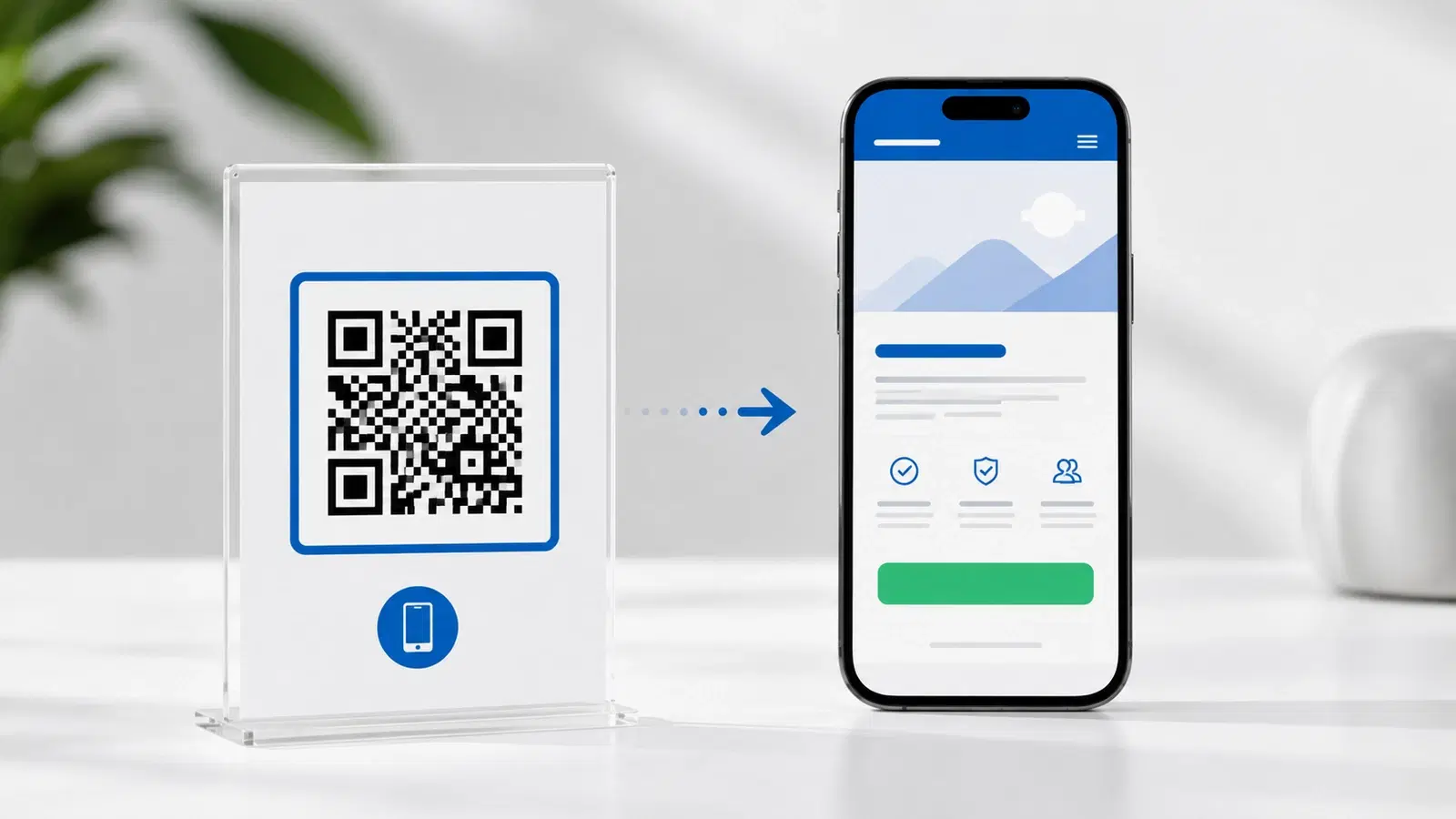
Almost all QR code advice focuses on the code: the size, the design, the placement, the call to action. All of that gets someone to scan. But the scan is not the goal. What happens after the scan, on the page that opens, is what decides whether that scan becomes a customer, a lead, or nothing at all.
This is the most underrated part of any QR code campaign. You can have a perfectly designed code, in a perfect location, with a compelling call to action, and still fail completely because the page it opens is slow, confusing, not mobile-friendly, or simply not what the scanner expected. The scan was a success; the landing page threw it away.
This guide is about that landing page: what to link your QR codes to, how to design a page that converts the scanner who arrives, and the mistakes that quietly waste otherwise successful scans. It is the natural companion to our guides on the psychology of QR code scanning, tracking in GA4, and A/B testing, completing the picture of a QR campaign that actually works end to end.
The Golden Rule: Deliver Exactly What Was Promised
The single most important principle of QR landing pages is continuity: the page must deliver exactly what the call to action promised, immediately.
Why this matters so much: Someone scanned because your call to action made a specific promise. "Scan for the menu." "Scan for 20 percent off." "Scan to book a table." They spent effort based on that promise. The landing page either keeps it instantly or breaks it, and breaking it is the fastest way to lose them.
The classic failure: The call to action says "Scan for our menu," and the code opens the website homepage. Now the scanner has to find the menu themselves. From their perspective, this is a broken promise, and many will simply give up. You did everything right up to the scan, then squandered it by linking to the wrong page.
The rule: The landing page must match the call to action precisely and immediately. If you promised the menu, the menu loads. If you promised a discount, the discount is right there. If you promised booking, the booking page opens. No hunting, no extra clicks, no homepage.
Scent and continuity: Marketers call this "information scent." The scanner is following a trail from your call to action to the reward, and every step where the trail is unclear loses people. A landing page that instantly, obviously delivers the promised thing keeps the scent strong and the scanner moving toward your goal.
The practical test: Read your call to action, scan your code, and ask: did I get exactly what was promised, immediately, without thinking? If the answer is anything less than an instant yes, the landing page is leaking scans. Fix it before anything else, because no other landing page optimization matters if the page does not deliver what was promised.
Pro Tip
Never point a QR code at your homepage when the call to action promised something specific. "Scan for the menu" must open the menu, not the homepage with a menu link somewhere on it. The mismatch between promise and page is the single most common and most costly QR landing page mistake.
Mobile-First, Because Every Scanner Is on a Phone
Every single person who scans a QR code is on a phone. This is obvious and yet constantly ignored, because landing pages are usually designed and reviewed on a desktop.
The non-negotiable requirement: The landing page must be excellent on mobile. Not acceptable, excellent. Since one hundred percent of your QR traffic is mobile, a page that works on desktop but is mediocre on mobile is a mediocre page for every scanner who sees it.
What mobile-excellent means:
Fast loading. Scanners are impatient, often on cellular data, sometimes on weak signal in a physical location. A slow page loses people in seconds. Speed is the first requirement, and it is where many pages fail, especially heavy pages full of large images and scripts.
Readable without zooming. Text large enough to read, buttons large enough to tap, no pinching or horizontal scrolling. A page that requires zooming to use is a page most scanners will abandon.
Thumb-friendly. Important actions reachable and tappable with a thumb. Buttons sized for fingers, not mouse cursors. Forms easy to complete on a phone keyboard.
No desktop assumptions. No hover-dependent interactions, no tiny close buttons, no layouts that assume a wide screen.
Why this gets missed: The person building the page reviews it on their computer, where it looks fine, and never experiences it as the scanner will. The fix is simple: always review your QR landing page on an actual phone, over cellular data, as a real scanner would. If it is not fast and effortless there, it is not ready.
The speed point deserves emphasis: Of all mobile factors, loading speed is the one that silently kills the most scans. A scanner standing in a shop or restaurant will not wait for a heavy page. Keep the landing page light and fast, and you keep scanners who a slow page would lose.
What to Link To: Matching Page to Purpose
Different campaigns need different landing pages. Matching the page type to the goal is part of getting conversions.
For a specific offer or promotion: A focused landing page with the offer front and center, a clear explanation, and one obvious action. Not your homepage, not a cluttered page. The offer, and the way to claim it, immediately visible.
For a menu, catalog, or information: The actual menu or information, mobile-optimized, loading fast. This is what the scanner wants; give it to them directly and cleanly.
For lead capture: A short, focused form. The critical rule: ask for as little as possible. Every additional field loses people. Name and email, or even just email, converts far better than a long form. You can gather more later; right now you want the lead, not their life story.
For booking or scheduling: The booking interface directly, not a page about booking. The scanner wants to book; open the calendar.
For contact saving: A vCard that saves directly, or a clean contact page with tap-to-call and tap-to-save. See our vCard guide.
For a product: The specific product page, with the key information and a clear path to purchase, not a category page or homepage.
The single-action principle: Whatever the purpose, the best QR landing pages have one clear primary action. A page that asks the scanner to do five things gets none of them done. Decide the one thing you want the scanner to do, make it obvious, and remove everything that competes with it. Focus converts; clutter does not.
The dynamic code advantage: Because a dynamic QR code lets you change the destination, you can point the same printed code at different optimized landing pages over time, or fix a poorly converting page without reprinting anything. This is what makes testing and improving landing pages practical, covered next. See how to edit a QR code after printing.
- Offer: a focused page with the offer and one action, not the homepage
- Menu or info: the actual content, fast and mobile-optimized
- Lead capture: the shortest possible form, ideally just email
- Booking: the calendar directly, not a page about booking
- Every page: one clear primary action, everything else removed
Measure, Test, and Improve the Page
The landing page is where conversion happens or does not, which makes it the highest-value thing to measure and improve. This is where QR marketing gets genuinely optimized.
Measure what happens on the page: Your QR platform tells you scans happened. Google Analytics 4 tells you what scanners did on the landing page: did they engage, convert, or bounce immediately. Connecting your codes to GA4 via UTM parameters is how you see this. See our GA4 tracking guide.
The diagnostic power of bounce data: If scanners arrive and immediately leave, the landing page is the problem: too slow, not mobile-friendly, or not matching the promise. High scans with high bounce is a landing page failure, and GA4 reveals it clearly. Without this data, you might blame the code when the page is at fault.
Test landing page variations: Because dynamic codes let you change the destination, you can A/B test landing pages: point the code at version A for a period, version B for another, and compare conversion. Test the offer presentation, the form length, the headline, the primary action. See our A/B testing guide.
What to test first:
- Form length, since shorter forms almost always convert better
- The headline and offer clarity, since confusion loses people fast
- The prominence and wording of the primary action button
- Page speed, since faster is almost always better
The full-funnel view: The complete picture connects three things: the call to action (does it make people scan), the code and placement (can they scan, do they), and the landing page (does the scan convert). A weakness in any one wastes the others. The landing page is the final and most decisive link, because it is where the scan either becomes a result or does not.
The optimization habit: Deploy, measure landing page behavior in GA4, identify where scanners drop off, improve the page, and measure again. Because dynamic codes let you improve the page without touching the printed code, this loop is entirely practical. A business that runs it turns a mediocre QR campaign into a converting one, using the landing page as the lever.
Conclusion
A QR code is only as good as the page it opens. Everything about the code, the design, the placement, the call to action, exists to produce a scan, and the scan is worthless if the landing page does not convert it. The landing page is the most underrated and most decisive part of any QR campaign.
The essentials are clear. Deliver exactly what the call to action promised, immediately, with no homepage detour. Make the page excellent on mobile, especially fast, because every scanner is on a phone. Match the page type to the purpose, and give it one clear primary action with everything else stripped away. Then measure what scanners do on the page in GA4, and use dynamic codes to test and improve the page without reprinting anything.
Get the landing page right and your scans start becoming customers. Get it wrong and even a perfect code in a perfect spot produces nothing. If you have optimized everything about your QR codes but not the pages they open, the landing page is where your next and biggest improvement is waiting.
Related reading:
Create dynamic QR codes with QRForever. Start a 7-day full-access trial, no credit card needed. Change the landing page anytime without reprinting, so you can test and improve what your codes open.
Explore QRForever Solutions
Ready to Create Your Own QR Codes?
Start creating dynamic QR codes for your business today. Track analytics, update content anytime, and never reprint again.
Related Articles
QR Code Marketing Strategy: 15 Campaign Types That Work in 2026
A practical QR code marketing playbook: 15 campaign types with real examples, a channel-by-channel breakdown, attribution setup, and the mistakes that quietly waste budget. Updated June 2026.
How to Create a QR Code for Google Reviews: Get More 5-Star Reviews in 2026
A Google Review QR code sends customers straight to your review page, no searching, no friction. Learn how to set it up, where to place it, and how businesses 3x their review count.
How to Create a QR Code for Your Instagram & Social Media Profiles in 2026
Link your Instagram, Facebook, YouTube, or any social profile to a QR code. Perfect for offline promotions, packaging, and events. Includes Linktree alternatives and multi-link setups.