QR Codes for Churches & Places of Worship: Giving, Connect Cards & Events (2026)
Churches and places of worship use QR codes to simplify giving, welcome newcomers, share sermons, and coordinate events without friction. Here is a practical, respectful 2026 guide to the highest-value use cases.

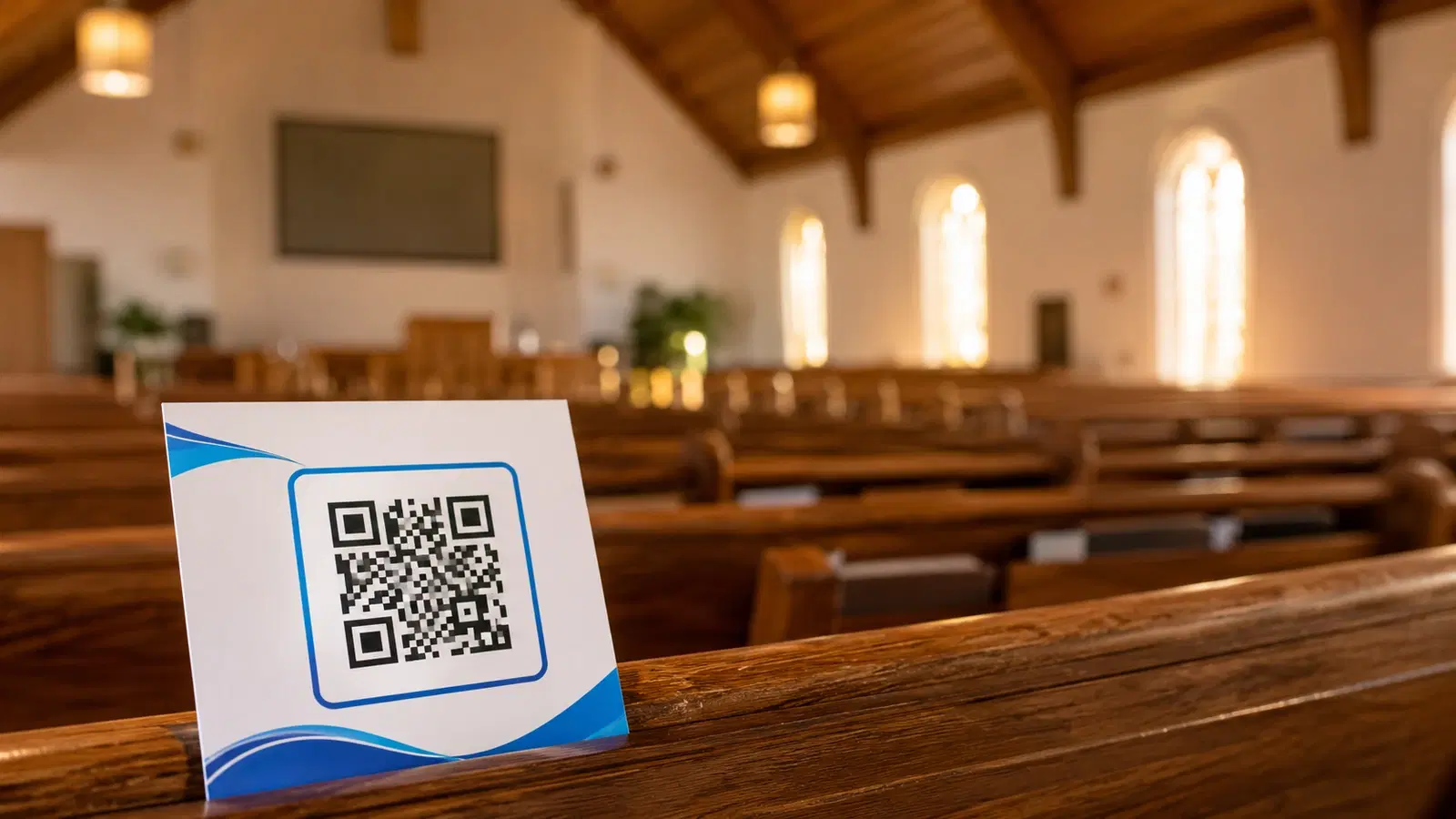
Churches and places of worship serve their communities through a mix of gathering, giving, teaching, and coordinating, and each of those has a small friction point that a QR code can quietly remove.
A member who wants to give but has no cash. A newcomer who wants to connect but does not know how. Someone who missed a sermon and wants to hear it. A congregation trying to sign up for a volunteer rota. In each case a printed QR code, placed thoughtfully, turns a moment of intent into a completed action in seconds.
This guide covers the highest-value QR code use cases for churches and other faith communities, with attention to doing it respectfully and without turning worship into a marketing exercise. It is a companion to our nonprofits guide, focused specifically on the rhythms of a worshipping community.
Use Case 1: Giving and Donations
Giving is the use case where QR codes help most, because the biggest barrier to giving is often simply that the moment passes.
The problem QR codes solve: A member intends to give but carries no cash, or the offering moment passes before they act, or they mean to set up online giving later and never do. Each of these is a completed intention lost to friction.
The QR code approach: A QR code in the bulletin, on the seat-back, on a giving station, or displayed on screen, linking directly to your giving page. The member scans and gives in the moment they feel moved to, from their own phone.
Where to place it:
- In the printed bulletin or order of service
- On a discreet card at each seat or pew
- At a dedicated giving kiosk or station
- On screen during the offering, if you use screens
- On the way out, for those who prefer to give as they leave
How to keep it respectful: The tone matters. A giving QR code should be offered, not pushed. Present it as a convenience for those who wish to give, alongside traditional methods, never as pressure. Language like "For those who would like to give electronically" respects that giving is a personal act.
A practical note on the platform: Use a proper giving or donation platform for the destination, and link a dynamic QR code to it so you can update the destination if you change providers without reprinting bulletins or cards. See how to edit a QR code after printing.
Pro Tip
Offer the giving QR code alongside traditional methods rather than replacing them. Some members prefer cash or cheque, and the offering plate has meaning for many. The QR code serves the members who would give electronically but currently lose the moment to friction, without taking anything away from anyone else.
Use Case 2: Connect Cards and Welcoming Newcomers
Welcoming newcomers is central to most faith communities, and the traditional paper connect card has a low completion rate. People take it, mean to fill it in, and never do.
The QR code approach: A QR code on the welcome card, in the bulletin, or on welcome signage, linking to a digital connect form. A newcomer scans, fills it in on their phone at their own pace, and the church receives their details to follow up.
What the connect form captures:
- Name and contact details
- Whether they are new or visiting
- Interests or questions
- Prayer requests
- Interest in small groups, volunteering, or next steps
Why it works better than paper:
- A newcomer can complete it quietly on their own phone rather than filling in a card in front of others
- The information reaches the right person immediately for follow-up
- No transcription of handwriting, no lost cards
- Follow-up can be prompt, which matters most in the first days after a visit
The welcoming principle: The goal is to lower the barrier to connection, not to collect data. Keep the form short and warm, ask only what helps you welcome the person, and make it clear how you will follow up. A newcomer who feels pursued rather than welcomed will not return.
This parallels the intake pattern used in other settings, covered in our schools guide for parent communication.
Use Case 3: Sermons, Teaching, and Content
Faith communities produce a lot of content, sermons, teaching series, study materials, and want members to engage with it beyond the service itself.
Sermon access QR codes: A QR code in the bulletin or on screen linking to the current sermon audio or video, or to your sermon archive. Members who missed a service, or who want to revisit a message, reach it in one scan. Visitors can catch up on a series.
Study and small group materials: A QR code linking to study guides, discussion questions, or reading plans tied to the current teaching. This supports the small groups and personal study that turn a Sunday message into ongoing engagement.
Scripture and reading plans: A QR code linking to a reading plan or the passages for a series, so members can follow along through the week.
Why a dynamic code is ideal here: Your current sermon and current series change constantly. A single dynamic QR code labeled "this week's message" can be repointed each week without reprinting anything. The same bulletin template, the same on-screen graphic, always links to the current content. See dynamic vs static QR codes.
Extending the reach: Content QR codes also help members share. A member who found a message meaningful can pass the link to a friend, which is how much church growth actually happens.
Use Case 4: Events, Volunteering, and Coordination
Faith communities run on volunteers and events, and coordinating both involves a lot of sign-up friction that QR codes reduce.
Event registration QR codes: For retreats, studies, socials, and special services, a QR code on the announcement linking to registration. Members sign up in the moment they hear about it rather than meaning to later. See our event check-in guide for the mechanics.
Volunteer sign-up QR codes: A QR code linking to volunteer rotas and opportunities, so members can offer to serve without tracking down the right coordinator. Particularly useful for one-off needs like a service project or a special event.
Newsletter and communication sign-up: A QR code inviting members to join the church email or messaging list, so announcements reach them reliably rather than depending on catching them in person.
Prayer requests: A QR code linking to a prayer request form, so members and visitors can share requests privately and have them reach the prayer team.
Children and youth check-in: Some churches use QR codes as part of secure children's ministry check-in, which improves both safety and speed at drop-off.
The coordination principle: Every one of these replaces a moment where a member had to remember to do something later with a moment where they can do it now. That shift from "later" to "now" is where the value is, because "later" is where most good intentions quietly die.
- Giving QR in the bulletin, at seats, and on screen, offered not pushed
- Connect card QR for warm, low-pressure newcomer follow-up
- Sermon and study QR, using one dynamic code repointed each week
- Event and volunteer sign-up QR to capture intent in the moment
- Newsletter and prayer request QR for reliable, private communication
Getting It Right: Practical and Pastoral Notes
A few considerations specific to faith communities help these tools serve rather than intrude.
Mind your congregation's comfort with technology. Some congregations are highly comfortable with phones in services; others are not, and some traditions discourage devices during worship. Read your community. QR codes on the way in and out, or in the bulletin to use at home, may fit better than codes displayed mid-service.
Always keep the traditional option. Offering plate, paper connect cards, and in-person sign-up should remain. QR codes serve the members who prefer digital, without excluding those who do not. Not everyone has a smartphone, and inclusion matters especially here. See our accessible QR codes guide.
Keep the tone pastoral, not commercial. The language around a giving or connect QR code should sound like a church, not a checkout. Warmth over urgency, invitation over pressure.
Protect privacy. Connect forms and prayer requests contain personal and sometimes sensitive information. Ensure the destination is secure, disclose how information is used, and never put anything private behind an openly public code without appropriate protection. See our privacy guide.
Use dynamic codes and test them. Because bulletins and materials are produced regularly, dynamic codes let you update destinations without waste. And test every code at the size it actually prints in your bulletin, which is often small. See our size guide.
Start with one. The most common mistake is adding QR codes everywhere at once. Start with the single highest-value use, usually giving or the connect card, get it working well, and expand from there.
Conclusion
For churches and places of worship, QR codes quietly remove the small frictions that cause good intentions to slip away. A giving code captures generosity in the moment it is felt. A connect card code welcomes a newcomer without putting them on the spot. A sermon code lets a message travel beyond the service. An event or volunteer code turns "I should sign up" into a completed sign-up.
The guiding principles are pastoral rather than technical: offer these tools alongside traditional methods rather than replacing them, keep the tone warm and the pressure absent, protect the personal information members share, and read your congregation's comfort with technology. Start with one high-value use, do it respectfully and well, and let the technology stay invisible so that what remains visible is the welcome and the community.
Related reading:
Create QR codes for your community with QRForever. Start a 7-day full-access trial, no credit card needed. Begin with your highest-value use, usually giving or the connect card.
Explore QRForever Solutions
Ready to Create Your Own QR Codes?
Start creating dynamic QR codes for your business today. Track analytics, update content anytime, and never reprint again.
Related Articles
QR Code Menus for Restaurants: The Complete Setup Guide (Updated 2026)
Step-by-step guide to implementing QR code menus in your restaurant. Covers menu format options, placement strategy, staff training, and the one mistake that causes reprints. Updated May 2026.
QR Codes for Events: Conferences, Trade Shows & Beyond (Updated 2026)
QR codes turn events from logistical pain into smooth data-rich experiences: instant check-in, smart networking, lead capture for exhibitors, and post-event ROI you can actually prove. Updated May 2026 with the current best practices.
QR Codes on Product Packaging: Engaging Consumers Beyond the Shelf (Updated 2026)
Product packaging is your most-distributed marketing surface. Every unit on every shelf, in every home. QR codes turn that surface into a measurable, updatable channel for engagement, loyalty, and product education. Updated September 2026.