QR Codes for Authors & Self-Published Books (Marketing Guide 2026)
A QR code in your book connects readers to bonus content, your mailing list, reviews, and your next book. For self-published authors, it turns a one-time reader into a long-term fan. Here is how to use QR codes to market your books in 2026.

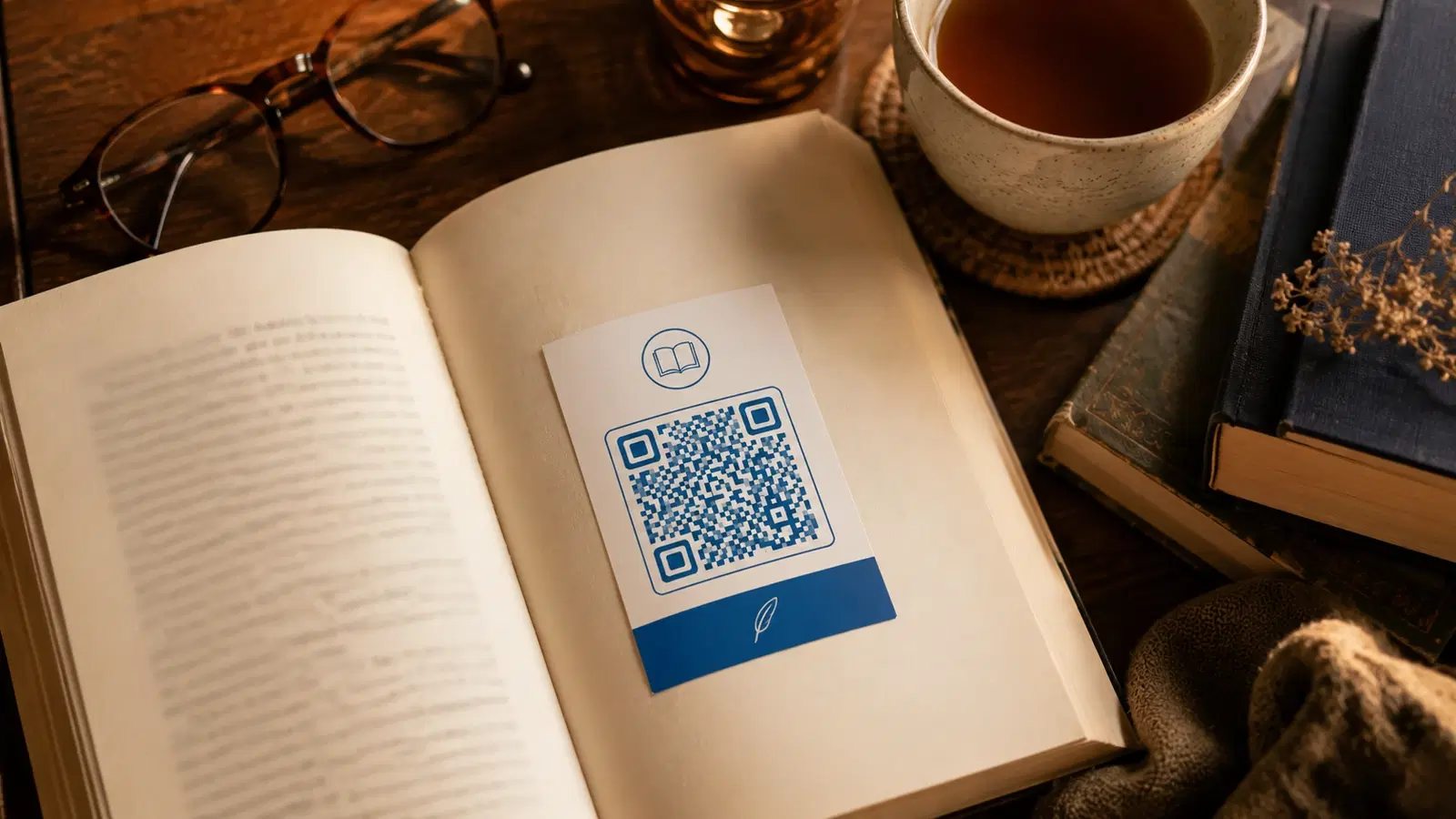
For a self-published author, the hardest part is not writing the book. It is building the connection between a reader who finishes your book and your future work. A reader who loves your novel but never joins your mailing list, leaves a review, or hears about your next release is a fan you lost.
A QR code printed in your book bridges that gap. It connects a reader, in the moment they are most engaged, to your mailing list, bonus content, a review page, or your next book. For self-published authors who own their reader relationships, this is one of the most valuable marketing tools available, and it costs almost nothing.
This guide covers how authors and self-publishers use QR codes to turn readers into long-term fans: mailing list growth, bonus content, reviews, selling the next book, and more. It applies to print books, where a clickable link is impossible and a QR code is the only bridge to digital.
Why QR Codes Matter Most for Print Books
Ebooks have clickable links. Print books do not. This is exactly why QR codes are so valuable for authors: in a physical book, a QR code is the only way to connect a reader to anything digital.
The core problem QR codes solve for authors: A reader finishes your print book, loves it, and closes the cover. Without a bridge, that is where the relationship ends. They may never find your website, never join your list, never leave a review, never learn about your next book. You have a fan with no way to nurture them.
The QR code bridge: A QR code in your book, at the right moment, lets that engaged reader take one action: scan and join your world. The book becomes not just a product but an entry point to an ongoing relationship.
Why this is high-leverage for self-publishers specifically: Traditional publishers own the reader relationship. Self-published authors own theirs directly, which means every reader you convert into a mailing list subscriber or repeat buyer is yours to keep. QR codes are the cheapest, most direct way to capture that relationship from print readers.
Use dynamic QR codes: A book stays in print and in readers' hands for years. Your mailing list provider changes, your website moves, your "next book" link needs to update with each new release. A dynamic QR code lets you update where the code points without reprinting the book. The code printed in a book you published two years ago can point to your newest release today. See QR codes that never expire.
Pro Tip
Always use a dynamic QR code in a book. Books outlive any single link. The "join my mailing list" code in your first novel should still work years later, and your "get my next book" code should point to whatever your latest release is, updated without reprinting a single copy.
Use Case 1: Grow Your Mailing List
For an author, an email list is the single most valuable marketing asset. It is the direct line to readers who will buy your next book on launch day, the audience you own regardless of platform changes.
The QR code approach: A QR code in your book offering something in exchange for an email signup, linking to your list signup page.
The reader-magnet that works: Offer something valuable and relevant: a free bonus chapter, a deleted scene, a prequel novella, a character guide, a companion short story, or exclusive content. "Want the bonus epilogue? Scan to get it free." This converts far better than a bare "join my newsletter."
Where to place it in the book:
- At the very end, right after the story concludes and the reader is most satisfied and engaged
- On the "about the author" page
- On a dedicated "get exclusive content" page near the back
Why the end of the book is the golden moment: A reader who just finished and loved your book is at peak motivation. That is the moment to offer them more and capture their email. A QR code there, with a compelling free offer, is one of the highest-converting list-building tools an author has.
Setup: Link a dynamic QR code to your mailing list signup page (Mailchimp, ConvertKit, MailerLite, etc.). The reader scans, enters their email, and receives the bonus content automatically. As you change providers or offers, update the destination without touching the printed book.
Use Case 2: Get More Reviews
Reviews are critical for self-published books. They drive visibility on Amazon and other platforms, build credibility with new readers, and influence the algorithms that surface your book. Yet most happy readers never leave one, simply because it is not easy in the moment.
The QR code approach: A QR code in your book linking directly to the review page, asking the reader to leave a review while they are still feeling the book.
Where to place it: At the end of the book, after the story, with a warm, honest ask: "If you enjoyed this book, a review means the world to an independent author. Scan to leave one, it takes two minutes."
Why this works for authors specifically: Readers genuinely want to support independent authors, but the friction of remembering to go to Amazon later kills most reviews. A QR code at the moment they finish, while the emotion is fresh, captures the review that would otherwise never happen.
An important honesty note: Link to the genuine review page and ask for an honest review. Do not incentivize reviews with payment or free gifts tied to leaving a review, which violates most platforms' policies. The ask itself, at the right moment, is enough. See our Google reviews guide for review-gathering principles that apply broadly.
The compounding effect: More reviews lead to more visibility, which leads to more readers, more of whom scan the code and leave reviews. For a self-published author, this review flywheel, kicked off by a simple QR code, can meaningfully change a book's trajectory.
Important
Never offer payment, free books, or gifts in exchange for reviews, and never link to a fake or manipulated review page. This violates Amazon and other platforms' policies and can get your book removed. Ask for honest reviews only. The QR code simply removes the friction; it must not manipulate the outcome.
Use Case 3: Sell Your Next Book & Series
If a reader loved this book, the most likely next sale is your next book. QR codes make that path effortless.
The QR code approach: A QR code at the end of the book linking to your other titles, your series page, or your author page where all your books live.
For series especially: A reader who finishes book one of a series is the hottest possible lead for book two. A QR code, "Continue the story, scan to get Book 2," placed right after the cliffhanger or conclusion, captures that reader at the exact moment they want more. This is one of the most direct sales QR codes an author can use.
For standalone books: A QR code linking to your full catalog or author page: "Enjoyed this? Discover my other books." The reader who loved your voice will explore your other work.
Why a dynamic code is essential here: Your catalog grows. When you publish your next book, you want every previously sold book to point readers to it. A dynamic QR code lets you update the destination so the code in your older books always promotes your newest release. The book you sold last year keeps selling your new book this year, automatically.
Placement: The very end of the book, after the story, is again the prime location. The reader has just finished and is deciding what to read next. Put the path to your next book directly in front of them.
Bonus Use Cases & Best Practices
Beyond the core three, authors use QR codes in creative ways:
Bonus and companion content: QR codes linking to maps for a fantasy world, character art, playlists that inspired the book, author commentary, or pronunciation guides. These deepen reader engagement and make your book feel richer.
Audiobook and format cross-promotion: A QR code in the print book linking to the audiobook or ebook version, capturing readers who want another format.
Social media and author platform: A QR code linking to your Instagram, TikTok (BookTok is a powerful discovery engine), or author website, where readers follow your journey and upcoming releases. See QR code for Instagram and social media.
Book club resources: A QR code linking to discussion questions and book club guides, encouraging group reads that multiply your readership.
Signed copies and merchandise: For author events, a QR code linking to where readers can buy signed copies or related merchandise.
Best practices for QR codes in books:
- Use dynamic codes always, since books are long-lived
- Place codes at the end, the moment of peak engagement, plus the about-the-author page
- Pair every code with a clear, compelling reason to scan ("Scan for the free bonus chapter")
- Keep codes clean and high-contrast so they scan reliably from a printed page, see our design guide
- Test the printed code before the full print run, see print vs digital QR codes
- Track scans to learn what readers actually engage with, see how to track QR code scans
The author's QR strategy in one sentence: Put a dynamic QR code at the end of every book offering bonus content for an email signup, plus a path to your next book, and you have built a reader-capture and re-sell engine that works automatically for the life of the book.
- Mailing list QR with a free bonus offer at the end of the book
- Honest review request QR at the moment the reader finishes
- Next-book or series QR to capture the hottest sales lead
- Bonus content QR to deepen engagement (maps, art, playlists)
- Social and BookTok QR to grow your author platform
- Always dynamic, always at peak-engagement placement, always with a clear reason to scan
Conclusion
For self-published authors, QR codes solve the fundamental problem of print: connecting an engaged reader to your digital world when no clickable link is possible. A QR code at the end of your book, offering bonus content for an email signup, captures the reader relationship you would otherwise lose. A review QR turns satisfied readers into the reviews that drive visibility. A next-book QR converts a finished reader into your next sale.
The strategy is simple and high-leverage: use dynamic codes so they keep working and stay current for the life of the book, place them at the moment of peak engagement (the end), and always pair them with a compelling reason to scan. For the cost of almost nothing, you build a reader-capture and re-sell engine that runs automatically across every copy you ever sell.
Related reading:
Create a dynamic QR code for your book with QRForever. Start a 7-day full-access trial, no credit card needed. Point it to your mailing list or next book, and keep it current for the life of every copy you sell.
Explore QRForever Solutions
Ready to Create Your Own QR Codes?
Start creating dynamic QR codes for your business today. Track analytics, update content anytime, and never reprint again.
Related Articles
QR Code Marketing Strategy: 15 Campaign Types That Work in 2026
A practical QR code marketing playbook: 15 campaign types with real examples, a channel-by-channel breakdown, attribution setup, and the mistakes that quietly waste budget. Updated June 2026.
How to Create a QR Code for Google Reviews: Get More 5-Star Reviews in 2026
A Google Review QR code sends customers straight to your review page, no searching, no friction. Learn how to set it up, where to place it, and how businesses 3x their review count.
How to Create a QR Code for Your Instagram & Social Media Profiles in 2026
Link your Instagram, Facebook, YouTube, or any social profile to a QR code. Perfect for offline promotions, packaging, and events. Includes Linktree alternatives and multi-link setups.