QR Codes for Real Estate Agents: Listings, Open Houses & Lead Capture (2026)
Real estate agents convert leads, not properties. This guide focuses on agent-side QR code tactics: capturing leads at open houses, follow-up workflows, and the QR code placements that consistently generate calls. Companion to our property-marketing guide.

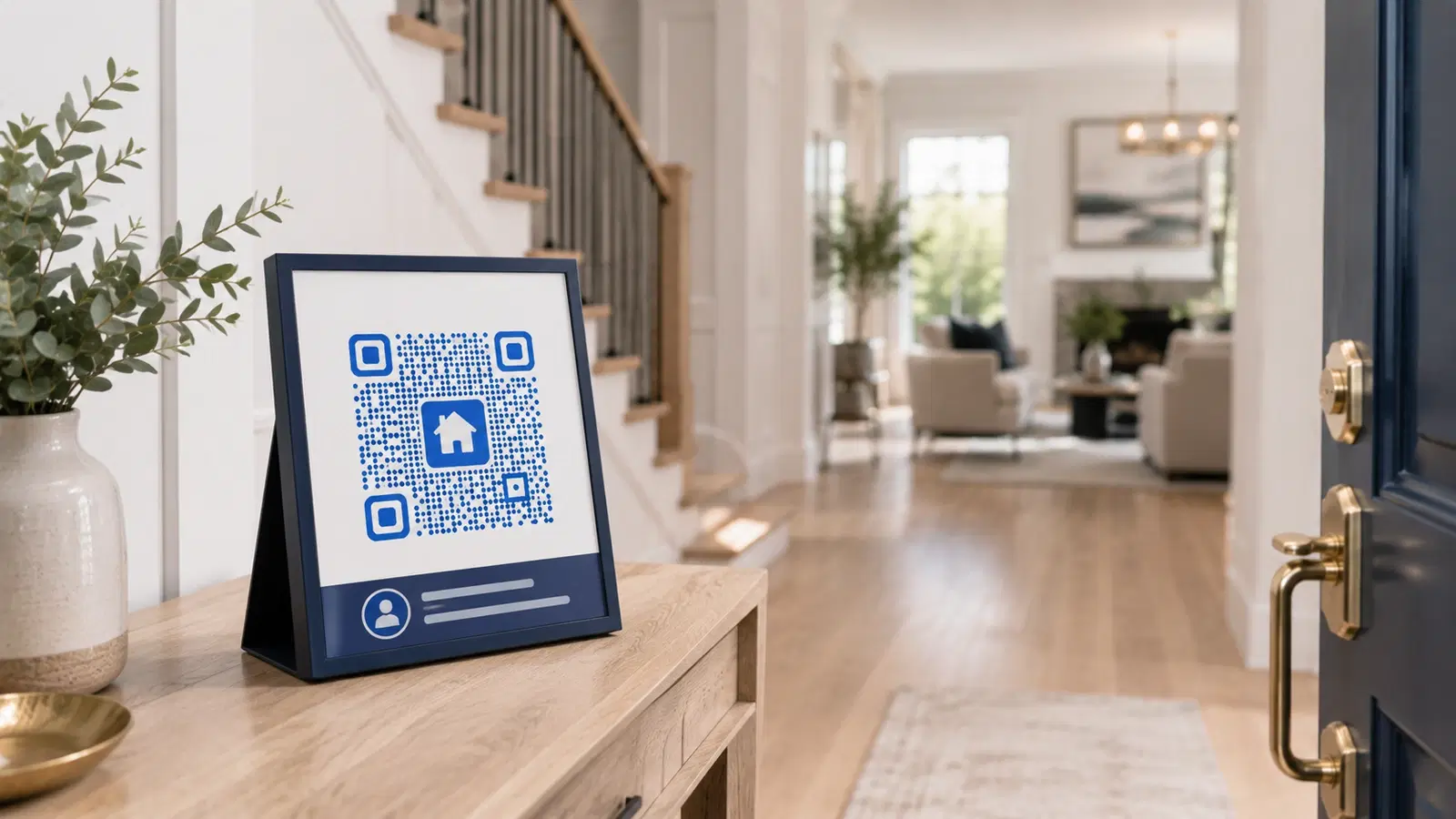
Real estate is an agent-led business. The property gets the search traffic; the agent converts it into a sale. Most QR code advice for real estate focuses on the *property*: listing flyers, yard signs, virtual tours. This guide focuses on the *agent*: how QR codes capture leads, build relationships, and drive the calls that actually generate commissions.
It's a deliberate companion piece to our real estate property marketing QR code guide. That one covers listing-focused tactics; this one is agent-focused.
This guide focuses on agent-specific lead capture; for a broader overview visit the QR codes for real estate page.
If you're a working real estate agent or part of a brokerage, this is your QR code playbook for lead capture and conversion.
The Agent-First Mental Model
Most QR code real estate advice optimizes for the wrong thing. It optimizes for "more views of the listing." But views don't pay commissions. Appointments do, and behind appointments are leads with phone numbers.
The mental shift: Every QR code an agent uses should be evaluated by one metric: *does this end with a lead in my CRM?* A QR code that drives 500 listing views but zero calls is worth less than a QR code that drives 50 views and 3 calls.
What this changes in practice:
- A QR code on a yard sign that points to the MLS listing → low value (anonymous view, no lead capture)
- A QR code on a yard sign that points to a "request more info" form → high value (captured lead)
- A QR code on the business card that points to your LinkedIn → low value (no follow-up trigger)
- A QR code on the business card that points to "book a 15-minute call with me" → high value (calendar booking = qualified lead)
The principle: Make every QR code's destination a *conversion event* (a form fill, a calendar booking, a phone call initiation), not a passive content view.
This is the single most underused insight in real estate QR codes. Most agents treat the QR code as a brochure. The agents who treat it as a lead-capture mechanism dramatically outperform.
Pro Tip
When designing a QR code's destination page, ask: "What action do I want the person to take in the next 60 seconds?" If the answer isn't a phone call, form submission, or calendar booking, redesign the page.
Use Case 1: Open House Lead Capture
Open houses are the highest-value QR code opportunity for an agent. Visitors are physically present, already interested in the property, and likely interested in other listings too.
The traditional approach: A paper sign-in sheet at the entrance. Half the visitors don't sign in (or sign in with fake names). Of those who do, half have illegible handwriting.
The QR code approach: A clearly displayed QR code at the entrance: "Sign in here to receive the listing details, neighborhood comps, and similar properties." Scanning takes them to a quick form: name, email, phone, interest level. They get a thank-you page with the listing PDF and an offer to receive similar listings.
Setup: 1. Build the form in a CRM-connected tool (Follow Up Boss, BoomTown, kvCORE, or even a simple JotForm linked to your CRM via Zapier) 2. The form captures: name, email, phone, "looking to buy in next X months," "are you working with another agent?" 3. The thank-you page delivers the promised listing PDF and offers a follow-up call booking 4. Create a dynamic QR code pointing to the form 5. Print a clean A4 sign for every open house: "Scan to sign in: receive this listing's details + 5 similar homes in this neighborhood"
Why this works:
- The value exchange is explicit (you give your contact info, you get genuinely useful information)
- Lead data is clean (typed into a form, not handwritten)
- Auto-enrollment in your email sequence captures lukewarm leads who weren't ready to talk that day
- The "similar listings" offer captures bigger value than just this one property
The follow-up sequence: Within 24 hours of the open house: a personal text or call to each sign-in. Mention something specific about the property they viewed. Offer to send neighborhood market analysis. This is where commissions are made.
Use Case 2: Yard Sign QR Codes (Done Right)
Yard signs are everywhere. The QR code on most yard signs leads to a passive MLS listing view. Better:
The right yard sign QR code workflow:
The QR code links to a *captured* property page. Your own brokerage's listing page (not just the MLS link), which includes: 1. The listing details (photos, price, features) 2. A "Get instant property details + 5 similar homes" form 3. A booking calendar for a phone call about this property 4. Your branding throughout (so the lead knows who they're talking to)
Why your own page beats MLS:
- MLS pages don't capture leads for you
- MLS pages don't show your other relevant listings
- MLS pages don't have your contact info prominently
- MLS pages give the lead to whoever they click on next
Setup options:
- Most major CRM platforms (Follow Up Boss, kvCORE, BoomTown, Chime) offer agent-branded property landing pages
- For independent agents: Wix/Squarespace + a simple form + a Calendly link works fine
The double-QR yard sign pattern: Some agents print TWO QR codes on yard signs:
- "Scan to see this home" → property page with capture
- "Scan to talk to me directly" → calendar booking or text-to-phone link
This separates the casual browser from the serious buyer. Both go into your CRM, but with different lead temperatures.
A note on permanence: Yard signs get reused across listings. Use dynamic QR codes that you can repoint to each new property. Reprinting yard signs every time a property changes is expensive and wasteful. See how to edit a QR code after printing.
Important
Never point a yard sign QR code to a static MLS link. The MLS will eventually deactivate that listing (when sold), and your yard sign becomes a dead link in someone's neighborhood. A dynamic QR code pointing to a page you control survives listing changes.
Use Case 3: Business Card QR Codes
An agent's business card is their highest-circulation physical asset. A static URL or LinkedIn link on the back is the bare minimum. A QR code that *drives action* is the upgrade.
Three high-converting business card QR destinations:
Option A. Direct calendar booking: QR code links to your Calendly (or similar) page: "Book a free 15-minute home-search consultation." The most-qualified version of "tell me how I can help."
Option B. Buyer/seller match form: QR code links to a short questionnaire: "Tell me about your home search (or sale) and I'll send you a personalized market analysis within 24 hours." Captures intent and segments leads.
Option C. Multi-link landing page: QR code links to a small landing page with multiple options:
- "Book a free consultation"
- "Get a free home valuation"
- "See my current listings"
- "Read recent reviews"
Lets the lead self-route to the option matching their stage.
What NOT to put as the QR destination:
- Your homepage (too generic, no clear next step)
- Your LinkedIn profile (low real estate intent)
- A static portfolio of past listings (passive content)
- A "contact me" page with a generic form (low conversion)
The pattern: Business card QR codes should make the lead take a *specific action* (book, fill out a form, get valuation), not just learn about you. Booking conversion from a business card QR is dramatically higher than view conversion.
Bonus. Different QR codes for different audiences: Some agents carry two business card variants:
- Buyer-focused card: QR code goes to "Find your dream home" form
- Seller-focused card: QR code goes to "Get your home's value" form
You hand the appropriate card based on context. Higher conversion than one generic card for both audiences.
For business card design specifics, see QR code on business card design guide.
Use Case 4: Buyer & Seller Lead Magnets
Real estate agents who consistently generate leads use lead magnets. Free downloadable resources that capture an email in exchange for value. QR codes deliver these to the physical world.
Lead magnet ideas that work:
For buyers:
- "First-Time Buyer Guide. 10 Mistakes to Avoid"
- "Neighborhood Comparison: [Neighborhood A] vs [Neighborhood B]"
- "How Much House Can You Afford? Free Calculator"
- "Top 5 Up-and-Coming Neighborhoods in [City] for 2026"
For sellers:
- "Free Home Valuation Tool"
- "Top 10 Renovations That Add the Most Value"
- "Staging Guide: How to Make Your Home Show-Ready in a Weekend"
- "What's My Home Worth? Real-Time CMA"
Setup: 1. Create the lead magnet (PDF, calculator, video, etc.) 2. Build a landing page that requires an email to download 3. Create a dynamic QR code pointing to the landing page 4. Distribute the QR code on: - Postcards mailed to target neighborhoods - Flyers handed out at community events - Coffee shop bulletin boards (with permission) - Print ads in local publications - Open house bag inserts - Door hangers in canvassed neighborhoods
Why lead magnets convert:
- Specific value (not generic "contact me")
- Self-selecting (only relevant buyers/sellers will engage)
- Email captured for long-term nurture (a 6-month buying journey lead becomes a closed deal next year)
- Trackable per distribution channel (each channel can have its own QR code → see which mailing produced the most leads)
The follow-up: The download is the start, not the end. The email triggers a follow-up sequence: market updates, new listing alerts, seasonal advice. Most agents who deploy lead magnets see their best leads 60–180 days after first download.
Use Case 5: Personal Brand & Referral QR Codes
Long-term agent success is built on referrals. Past clients recommending you to family and friends. QR codes amplify this.
Past-client referral QR code: On every gift, holiday card, or thank-you note sent to past clients, include a QR code linking to a simple referral form: "Know someone buying or selling? Share their name and I'll send you a thank-you gift if they close." Makes referring frictionless.
Google review QR code: On the closing-day gift and the one-year-after-closing card, a QR code linking to your Google review page: "If you had a great experience, would you share it on Google?" Most past clients are happy to do this. They just need the prompt and the easy path. See QR code for Google reviews.
Testimonial / case study QR code: For each successful transaction, create a short case study page. A QR code on your marketing materials links to a curated portfolio of testimonials and case studies. Builds trust faster than a generic "satisfied customers" claim.
Community engagement QR code: For agents who sponsor local events, donate to community causes, or write neighborhood newsletters, a QR code on your event/donation materials links to your community engagement page. Reinforces your "local expert" positioning.
Personal video introduction QR code: A QR code on your business card or marketing materials linking to a 60-second video introducing yourself. Cold leads convert dramatically better after seeing the agent on video than reading a bio. Pre-records once, used forever.
- Referral request QR on every past-client touchpoint
- Google review QR on closing-day gift and anniversary cards
- Testimonial portfolio QR on all marketing materials
- Community engagement QR for sponsorships and events
- Personal video introduction QR on business cards
Tracking What Works (Per-Channel QR Codes)
One of the most underused agent strategies: separate QR codes for each distribution channel so you can see what's actually generating leads.
The setup:
- QR code on yard signs → tracks open-house and yard-sign-generated leads
- QR code on postcards → tracks direct-mail-generated leads
- QR code on business cards → tracks face-to-face-meeting leads
- QR code on social media graphics → tracks social-generated leads
- QR code on community event flyers → tracks event-generated leads
Each QR code points to a similar destination (your lead capture form), but the analytics tell you which channel is producing.
Why this matters: Most agents spend evenly across many channels (postcards, online ads, networking events, sponsorships), without knowing which channel is actually generating leads. Per-channel QR codes give you that data within 90 days.
The decision this enables: After 90 days of data:
- "Postcards generated 12 leads, 2 closings → keep doing"
- "Coffee shop flyers generated 3 leads, 0 closings → stop"
- "Open house QR codes generated 47 leads, 5 closings → invest more here"
For agents spending $500–$2000/month on marketing, this kind of attribution is the difference between scaling what works and burning budget on what doesn't.
For broader analytics setup, see how to track QR code scans without an app.
Conclusion
Real estate agents who treat QR codes as lead-capture mechanisms (not just brochures), consistently outperform agents who don't. The mental model: every QR code should end with a lead in your CRM, not a passive view.
Priority order for implementation: 1. Open house sign-in QR code (highest immediate ROI) 2. Yard sign QR code pointing to your own capture page (not MLS) 3. Business card QR code routing to direct booking or buyer/seller form 4. Lead magnet QR codes for postcards and physical marketing 5. Past-client referral and review QR codes for long-term compounding
Use dynamic QR codes throughout (properties change, marketing changes, brokerages change), and use per-channel QR codes to attribute leads to specific marketing spend. The agents who do this consistently build defensible lead pipelines; the agents who don't lose budget to channels that don't work.
Related reading:
Set up your agent QR codes with QRForever. Start a 7-day full-access trial, no credit card. Dynamic codes are editable anytime with full scan analytics. Start with the highest-ROI use case: open house sign-in.
Explore QRForever Solutions
Ready to Create Your Own QR Codes?
Start creating dynamic QR codes for your business today. Track analytics, update content anytime, and never reprint again.
Related Articles
QR Code Menus for Restaurants: The Complete Setup Guide (Updated 2026)
Step-by-step guide to implementing QR code menus in your restaurant. Covers menu format options, placement strategy, staff training, and the one mistake that causes reprints. Updated May 2026.
QR Codes for Events: Conferences, Trade Shows & Beyond (Updated 2026)
QR codes turn events from logistical pain into smooth data-rich experiences: instant check-in, smart networking, lead capture for exhibitors, and post-event ROI you can actually prove. Updated May 2026 with the current best practices.
QR Codes on Product Packaging: Engaging Consumers Beyond the Shelf (Updated 2026)
Product packaging is your most-distributed marketing surface. Every unit on every shelf, in every home. QR codes turn that surface into a measurable, updatable channel for engagement, loyalty, and product education. Updated September 2026.