State of QR Code Usage in India: 2026 Data Report
India is the largest market in our data by a wide margin. This report analyzes more than 60,000 real, anonymized QR code scans from India across the QRForever platform in 2026: the scale, the device reality, and what people actually scan.

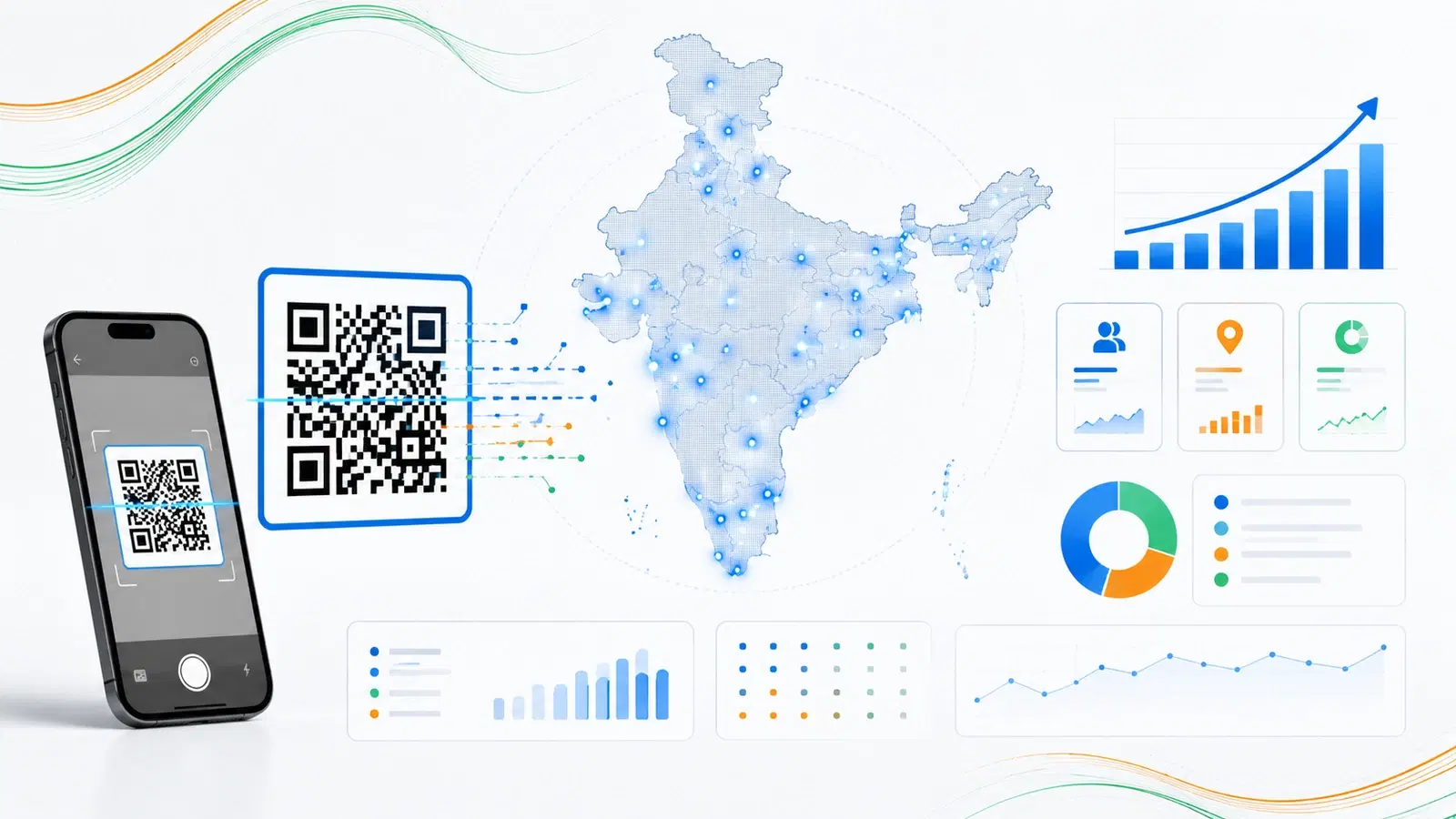
India is, without exaggeration, one of the most QR-code-fluent countries on earth. UPI turned QR-based payment into an everyday reflex for hundreds of millions of people, and that habit has spilled into every other kind of QR code, from menus to marketing to information.
That reality shows up starkly in our platform data. Of more than 70,000 total QR code scans across the QRForever platform, India accounts for more than 60,000 of them, the largest share by a very wide margin. That makes India not just a market we serve but the dominant one in our data, which gives us an unusually clear, real-world view of how QR codes are actually scanned in India.
This report shares what those more than 60,000 real, anonymized India scans reveal, current as of August 2026. As with all our data reporting, a clear note on scope: this is QRForever platform data, not a measure of all QR code activity in India. It reflects how QR codes are scanned across our user base and their audiences, which is genuinely India-heavy, but it is our platform's data, transparently labeled. It is a companion to our broader QR code statistics 2026 report.
The Scale: India Dominates the Data
The first and most striking finding is simply how much of the total India represents.
More than 60,000 of over 70,000 total scans came from India. That is more than 80% of all scans across the entire platform, from a single country. No other country comes close. The second-largest source of scans, the United States, accounts for a small fraction of India's total. India is not merely the leading market in this data; it is the overwhelming majority of it.
Why India is so QR-fluent: This concentration reflects a genuine reality about India, amplified by our particular user base. India's embrace of QR codes is arguably the most complete of any large economy, driven by UPI. When a country's population learns to scan QR codes to pay for a cup of tea from a street vendor, scanning becomes second nature, and that fluency carries into every other context: menus, marketing, information, and more. India did not adopt QR codes cautiously; it made them a daily reflex.
An honest note on the concentration: This India-heavy distribution reflects QRForever's specific user base as much as it reflects India's QR fluency. A different platform would show a different mix. We report the real figures because transparency is the point. What the data can genuinely tell us, given the large India sample, is how QR scanning behaves in India specifically, and that is what the rest of this report examines.
The size of the sample matters: More than 60,000 real scans from a single country is a substantial, meaningful dataset. It is large enough to reveal genuine behavioral patterns in how Indian users scan QR codes, which is what makes this India-specific view worth reporting on its own, rather than folding it into the global numbers. For UPI specifically, see our UPI payments guide for merchants.
India Scans on Mobile, Almost Exclusively
The device data from India reinforces, and if anything intensifies, the mobile-first reality of QR codes.
QR scanning in India is a mobile phone behavior, overwhelmingly. Consistent with the platform overall, the vast majority of India scans, well over 95%, come from mobile phones. This fits India's mobile-first internet reality: for a very large share of Indians, the smartphone is not one way they access the internet, it is the way. QR codes, scanned with the phone's camera, slot perfectly into that mobile-centric digital life.
Why this is even more true in India: India's internet growth happened primarily on mobile. Many users came online for the first time on a smartphone, skipping the desktop era that shaped Western internet habits. In that context, a QR code scanned by a phone camera is not a novelty bridging desktop and mobile; it is simply how the mobile-native user interacts with the physical world. The near-total mobile dominance in the India data reflects this.
The practical implication for anyone targeting India: If your QR codes are aimed at an Indian audience, mobile is not a consideration, it is the entire game. Your landing pages must be fast and excellent on mobile, and ideally lightweight enough to load quickly on variable mobile connections. A heavy, desktop-first page will fail almost every Indian scanner. See our landing pages guide.
The consistency point: That both the India data and the global platform data show more than 95% mobile scanning tells us this is not a quirk of one market. Mobile dominance is the universal reality of QR codes, and India, as the largest market in the data, exemplifies it.
Pro Tip
For an Indian audience, keep QR landing pages light and fast, not just mobile-friendly. Many scans happen on mobile data connections of varying speed, and a heavy page that loads slowly loses the scanner. Lightweight and quick beats feature-rich and slow for nearly every Indian scan.
What Indian Users Scan
The QR type data shows what Indian users are actually pointing their cameras at, and it mirrors the platform-wide pattern with an even stronger tilt toward the simple and practical.
URL codes dominate. As across the platform, the large majority of India scans are of URL-type codes: codes that link to a web page. Whatever the specific purpose, menu, offer, information, catalogue, the underlying action is overwhelmingly "take me to a web page."
The everyday, practical use pattern: The dominance of URL codes, followed at a distance by document (PDF) and other types, paints a picture of QR codes used for ordinary, practical purposes: linking customers to menus, information, catalogues, and pages. This is QR codes as everyday utility, not novelty, which fits a market where scanning is already a daily habit.
The UPI context, an important clarification: It is worth being precise here. UPI payment QR codes, which are central to India's QR fluency, run through the payment system infrastructure, not through a general QR platform like ours. So this data does not capture UPI payment scans directly. What it captures is the marketing, information, and business QR codes that Indian businesses use alongside their UPI payment codes. In other words, the data shows how QR fluency built by UPI has spread into every other kind of QR code, which is arguably the more interesting story. We cover the UPI side separately in our UPI payments guide.
The practical takeaway for Indian businesses: The data confirms that the highest-value QR codes for most Indian businesses are the practical ones: a URL code to your menu, your catalogue, your Google reviews, your WhatsApp. These everyday, web-linking codes are what the market actually scans. For a market-specific guide, see the best QR code generator options for India.
- URL codes dominate India scans, as they do platform-wide
- Document (PDF) codes follow at a distance
- The pattern reflects everyday, practical, web-linking use
- UPI payment scans run through payment infrastructure, not captured here
- The data shows UPI-built QR fluency spreading to all other QR types
What India Tells Us About the Future of QR Codes
Because India is further along the QR adoption curve than almost any other large economy, its behavior offers a preview of where widespread QR fluency leads.
India shows what "post-adoption" QR usage looks like. In many markets, the QR code conversation is still partly about adoption: will people scan, do they understand it, is it worth adding. In India, that question is long settled. Scanning is a reflex. This makes India a useful window into what QR usage looks like once adoption is complete and the technology is simply part of daily life.
The lesson: QR codes become invisible utility. What India's data and daily reality show is that once QR fluency is universal, QR codes stop being remarkable and become invisible utility, like a light switch. Nobody in India is impressed by a QR code; they just scan it. This is the end state of the technology everywhere, and India is already there. It reinforces the theme of our why QR codes survived guide: the destination of a successful technology is to become unremarkable.
What other markets can learn from India:
- Scanning becomes a reflex once there is a compelling, universal reason to start (for India, UPI). The habit, once formed, transfers to every other QR context.
- Mobile-first is absolute in a mobile-first market. Design accordingly.
- The practical, web-linking uses dominate. The exotic QR types matter less than a good page behind a simple URL code.
The honest bottom line: This report reflects QRForever's India-heavy user base, transparently labeled, not a census of all Indian QR activity. But with more than 60,000 real scans, it offers a genuine, verifiable window into how QR codes behave in the market that has embraced them most completely. And what it shows is a market where QR codes have fully crossed from novelty into invisible, everyday infrastructure, which is where the rest of the world is heading.
For Indian businesses specifically, the practical guides that follow from this data are our India generator guide, UPI payments guide, and India QR rules guide.
Conclusion
India dominates our platform data, accounting for more than 60,000 of over 70,000 total scans, and that large real sample offers a clear view of how QR codes are actually used in the market that has embraced them most fully. The findings are consistent and telling: scanning in India is overwhelmingly mobile, well over 95% on phones, in keeping with the country's mobile-first internet. It is overwhelmingly about linking to web pages. And it reflects a market where scanning is a settled daily reflex rather than a novelty.
The deeper story is what India previews for everyone else. Having crossed fully into universal QR fluency, driven by UPI and spread to every other kind of QR code, India shows what the end state looks like: QR codes as invisible everyday utility, scanned without a second thought. That is where widespread adoption leads, and India is already there.
As always, we share this as transparent first-party data, clearly labeled as QRForever's India-heavy platform usage rather than a census of all Indian QR activity, and rounded down so the real figures are somewhat higher. If you cite it, please note it is QRForever platform data as of August 2026.
Related reading:
Create QR codes for your Indian business with QRForever. Start a 7-day full-access trial, no credit card needed. INR pricing, Razorpay payments, and native WhatsApp QR codes.
Explore QRForever Solutions
Ready to Create Your Own QR Codes?
Start creating dynamic QR codes for your business today. Track analytics, update content anytime, and never reprint again.
Related Articles

The Future of QR Codes: Predictions for 2026 and Beyond
What is coming next for QR codes: AR integration, AI personalization, and payment evolution. An honest look at which predictions materialized, which did not, and what to expect. Updated July 2026.
QR Code Trends 2026: 10 New Use Cases Emerging This Year
QR codes have moved well past restaurant menus. From packaging transparency to memorial pages, event access, and offline creator growth, here are ten use cases genuinely gaining ground in 2026 and what they signal about where QR is heading.
Why QR Codes Survived (and Thrived) After COVID: A 2026 Retrospective
QR codes had failed before. The pandemic gave them a second chance, and this time they stuck. Here is an honest look at why the technology that flopped in 2012 became permanent infrastructure by 2026, and what actually changed.